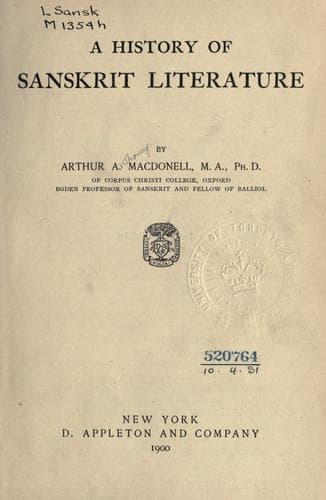
A History of Sanskrit LiteratureMacdonell, Arthur Anthony
History
A History of Sanskrit Literature
Macdonell, Arthur Anthony
Sanskrit literature -- History and criticism
There are also some modern anthologies of Sanskrit gnomic poetry. One
of these is Çridharadasa's Sadukti-karnamrita, or "Ear-nectar of
Good Maxims," containing quotations from 446 poets, mostly of Bengal,
and compiled in 1205 A.D. The Çarngadhara-paddhati, or "Anthology of
Çarngadhara," dating from the fourteenth century, comprises about 6000
stanzas culled from 264 authors. The Subhashitavali, or "Series of
Fine Sayings," compiled by Vallabhadeva, contains some 3500 stanzas
taken from about 350 poets. All that is best in Sanskrit sententious
poetry has been collected by Dr. Böhtlingk, the Nestor of Indianists,
in his Indische Sprüche. This work contains the text, critically edited
and accompanied by a prose German translation, of nearly 8000 stanzas,
which are culled from the whole field of classical Sanskrit literature
and arranged according to the alphabetical order of the initial word.
Though composed in Pali, the Dhammapada may perhaps be mentioned
here. It is a collection of aphorisms representing the most beautiful,
profound, and poetical thoughts in Buddhist literature.
The keynote prevailing in all this poetry is the doctrine of the vanity
of human life, which was developed before the rise of Buddhism in the
sixth century B.C., and has dominated Indian thought ever since. There
is no true happiness, we are here taught, but in the abandonment of
desire and retirement from the world. The poet sees the luxuriant
beauties of nature spread before his eyes, and feels their charm;
but he turns from them sad and disappointed to seek mental calm and
lasting happiness in the solitude of the forest. Hence the picture
of a pious anchorite living in contemplation is often painted with
enthusiasm. Free from all desires, he is as happy as a king, when the
earth is his couch, his arms his pillow, the sky his tent, the moon
his lamp, when renunciation is his spouse, and the cardinal points
are the maidens that fan him with winds. No Indian poet inculcates
renunciation more forcibly than Bhartrihari; the humorous and ironical
touches which he occasionally introduces are doubtless due to the
character of this remarkable man, who wavered between the spiritual
and the worldly life throughout his career.
Renunciation is not, however, the only goal to which the transitoriness
of worldly goods leads the gnomic poets of India. The necessity of
pursuing virtue is the practical lesson which they also draw from
the vanity of mundane existence, and which finds expression in many
noble admonitions:--
Transient indeed is human life,
Like the moon's disc in waters seen:
Knowing how true this is, a man
Should ever practise what is good (Hit. iv. 133).
Public-domain text, read in full here on John Shaqi.
Reviews
Reviews
No reviews yet
Be the first to share your thoughts on this work.
Elsewhere in the archive
Join the Discussion
Join the discussion
Sign in to leave a comment or review.
Sign InorCreate an account