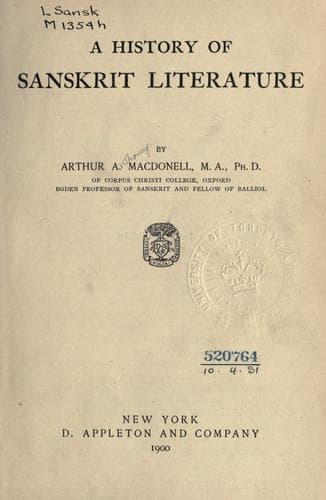
A History of Sanskrit LiteratureMacdonell, Arthur Anthony
History
A History of Sanskrit Literature
Macdonell, Arthur Anthony
Sanskrit literature -- History and criticism
It is often said that when a man dies and leaves all his loved ones
behind, his good works alone can accompany him on his journey to his
next life. Nor should sin ever be committed in this life when there
is none to see, for it is always witnessed by the "old hermit dwelling
in the heart," as the conscience is picturesquely called.
That spirit of universal tolerance and love of mankind which enabled
Buddhism to overstep the bounds not only of caste but of nationality,
and thus to become the earliest world-religion, breathes throughout
this poetry. Even the Mahabharata, though a work of the Brahmans,
contains such liberal sentiments as this:--
Men of high rank win no esteem
If lacking in good qualities;
A Çudra even deserves respect
Who knows and does his duty well (xiii. 2610).
The following stanza shows how cosmopolitan Bhartrihari was in his
views:--
"This man's our own, a stranger that":
Thus narrow-minded people think.
However, noble-minded men
Regard the whole world as their kin.
But these poets go even beyond the limits of humanity and inculcate
sympathy with the joys and sorrows of all creatures:--
To harm no living thing in deed,
In thought or word, to exercise
Benevolence and charity:
Virtue's eternal law is this (Mahabh. xii. 5997).
Gentleness and forbearance towards good and bad alike are thus
recommended in the Hitopadeça:--
Even to beings destitute
Of virtue good men pity show:
The moon does not her light withdraw
Even from the pariah's abode (i. 63).
The Panchatantra, again, dissuades thus from thoughts of revenge:--
Devise no ill at any time
To injure those that do thee harm:
They of themselves will some day fall,
Like trees that grow on river banks.
The good qualities of the virtuous are often described and contrasted
with the characteristics of evil-doers. This, for instance, is how
Bhartrihari illustrates the humility of the benevolent:--
The trees bend downward with the burden of their fruit,
The clouds bow low, heavy with waters they will shed:
The noble hold not high their heads through pride of wealth;
Thus those behave who are on others' good intent (i. 71).
Many fine thoughts about true friendship and the value of intercourse
with good men are found here, often exemplified in a truly poetical
spirit. This, for instance, is from the Panchatantra:--
Who is not made a better man
By contact with a noble friend?
A water-drop on lotus-leaves
Assumes the splendour of a pearl (iii. 61).
It is perhaps natural that poetry with a strong pessimistic
colouring should contain many bitter sayings about women and their
character. Here is an example of how they are often described:--
Public-domain text, read in full here on John Shaqi.
Reviews
Reviews
No reviews yet
Be the first to share your thoughts on this work.
Elsewhere in the archive
Join the Discussion
Join the discussion
Sign in to leave a comment or review.
Sign InorCreate an account