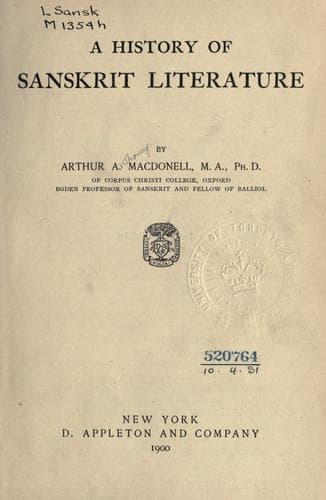
A History of Sanskrit LiteratureMacdonell, Arthur Anthony
History
A History of Sanskrit Literature
Macdonell, Arthur Anthony
Sanskrit literature -- History and criticism
The love of women but a moment lasts.
Like colours of the dawn or evening red;
Their aims are crooked like a river's course;
Inconstant are they as the lightning flash;
Like serpents, they deserve no confidence (Kathas. xxxvii. 143).
At the same time there are several passages in which female character
is represented in a more favourable light, and others sing the praise
of faithful wives.
Here, too, we meet with many pithy sayings about the misery of poverty
and the degradation of servitude; while the power of money to invest
the worthless man with the appearance of every talent and virtue is
described with bitter irony and scathing sarcasm.
As might be expected, true knowledge receives frequent and high
appreciation in Sanskrit ethical poetry. It is compared with a
rich treasure which cannot be divided among relations, which no
thief can steal, and which is never diminished by being imparted to
others. Contempt, on the other hand, is poured on pedantry and spurious
learning. Those who have read many books, without understanding their
sense, are likened to an ass laden with sandal wood, who feels only
the weight, but knows nothing of the value of his burden.
As the belief in transmigration has cast its shadow over Indian thought
from pre-Buddhistic times, it is only natural that the conception
of fate should be prominent in Sanskrit moral poetry. Here, indeed,
we often read that no one can escape from the operation of destiny,
but at the same time we find constant admonitions not to let this
fact paralyse human effort. For, as is shown in the Hitopadeça and
elsewhere, fate is nothing else than the result of action done in a
former birth. Hence every man can by right conduct shape his future
fate, just as a potter can mould a lump of clay into whatever form
he desires. Human action is thus a necessary complement to fate;
the latter cannot proceed without the former any more than a cart,
as the Hitopadeça expresses it, can move with only one wheel. This
doctrine is inculcated with many apt illustrations. Thus in one
stanza of the Hitopadeça it is pointed out that "antelopes do not
enter into the mouth of the sleeping lion"; in another the question
is asked, "Who without work could obtain oil from sesamum seeds?" Or,
as the Mahabharata once puts it, fate without human action cannot be
fulfilled, just as seed sown outside the field bears no fruit.
For those who are suffering from the assaults of adverse fate there
are many exhortations to firmness and constancy. The following is a
stanza of this kind from the Panchatantra:--
In fortune and calamity
The great ever remain the same:
The sun is at its rising red,
Red also when about to set.
Public-domain text, read in full here on John Shaqi.
Reviews
Reviews
No reviews yet
Be the first to share your thoughts on this work.
Elsewhere in the archive
Join the Discussion
Join the discussion
Sign in to leave a comment or review.
Sign InorCreate an account