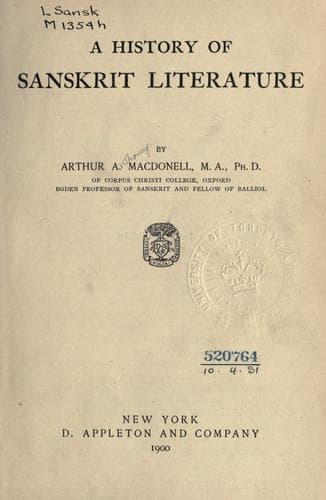
A History of Sanskrit LiteratureMacdonell, Arthur Anthony
History
A History of Sanskrit Literature
Macdonell, Arthur Anthony
Sanskrit literature -- History and criticism
Collected in the ethico-didactic works which have been described in
this chapter, and scattered throughout the rest of the literature,
the notions held by the Brahmans in the sphere of moral philosophy
have never received a methodical treatment, as in the Pali literature
of Buddhism. In the orthodox systems of Hindu philosophy, to which
we now turn, they find no place.
CHAPTER XV
PHILOSOPHY
The beginnings of Indian philosophy, which are to be found in the
latest hymns of the Rigveda and in the Atharvaveda, are concerned with
speculations on the origin of the world and on the eternal principle
by which it is created and maintained. The Yajurveda further contains
fantastic cosmogonic legends describing how the Creator produces all
things by means of the omnipotent sacrifice. With these Vedic ideas
are intimately connected, and indeed largely identical, those of the
earlier Upanishads. This philosophy is essentially pantheistic and
idealistic. By the side of it grew up an atheistic and empirical school
of thought, which in the sixth century B.C. furnished the foundation
of the two great unorthodox religious systems of Buddhism and Jainism.
The Upanishad philosophy is in a chaotic condition, but
the speculations of this and of other schools of thought were
gradually reduced to order and systematised in manuals from about
the first century of our era onwards. Altogether nine systems may
be distinguished, some of which must in their origin go back to the
beginning of the sixth century B.C. at least. Of the six systems which
are accounted orthodox no less than four were originally atheistic,
and one remained so throughout. The strangeness of this fact disappears
when we reflect that the only conditions of orthodoxy in India were
the recognition of the class privileges of the Brahman caste and
a nominal acknowledgment of the infallibility of the Veda, neither
full agreement with Vedic doctrines nor the confession of a belief in
the existence of God being required. With these two limitations the
utmost freedom of thought prevailed in Brahmanism. Hence the boldest
philosophical speculation and conformity with the popular religion
went hand and hand, to a degree which has never been equalled in any
other country. Of the orthodox systems, by far the most important
are the pantheistic Vedanta, which, as continuing the doctrines of
the Upanishads, has been the dominant philosophy of Brahmanism since
the end of the Vedic period, and the atheistic Sankhya, which, for
the first time in the history of the world, asserted the complete
independence of the human mind and attempted to solve its problems
solely by the aid of reason.
Public-domain text, read in full here on John Shaqi.
Reviews
Reviews
No reviews yet
Be the first to share your thoughts on this work.
Elsewhere in the archive
Join the Discussion
Join the discussion
Sign in to leave a comment or review.
Sign InorCreate an account