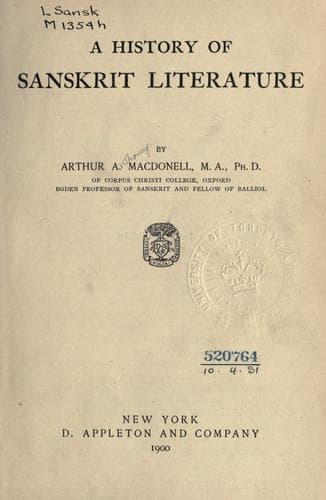
A History of Sanskrit LiteratureMacdonell, Arthur Anthony
History
A History of Sanskrit Literature
Macdonell, Arthur Anthony
Sanskrit literature -- History and criticism
Kapila, the founder of the system, whose teaching is presupposed
by Buddhism, and whom Buddhistic legend connects with Kapila-vastu,
the birthplace of Buddha, must have lived before the middle of the
sixth century. No work of his, if he ever committed his system to
writing, has been preserved. Indeed, the very existence of such a
person as Kapila has been doubted, in spite of the unanimity with
which Indian tradition designates a man of this name as the founder
of the system. The second leading authority of the Sankhya philosophy
was Panchaçikha, who may have lived about the beginning of our era. The
oldest systematic manual which has been preserved is the Sankhya-karika
of Içvara-krishna. As it was translated into Chinese between 557 and
583 A.D., it cannot belong to a later century than the fifth, and
may be still older. This work deals very concisely and methodically
with the doctrines of the Sankhya in sixty-nine stanzas (composed in
the complicated Arya metre), to which three others were subsequently
added. It appears to have superseded the Sutras of Panchaçikha, who
is mentioned in it as the chief disseminator of the system. There are
two excellent commentaries on the Sankhya-karika, the one composed
about 700 A.D. by Gaudapada, and the other soon after 1100 A.D. by
Vachaspati Miçra.
The Sankhya Sutras, long regarded as the oldest manual of the
system, and attributed to Kapila, were probably not composed till
about 1400 A.D. The author of this work, which also goes by the
name of Sankhya-pravachana, endeavours in vain to show that there
is no difference between the doctrines of the Sankhya and of the
Upanishads. He is also much influenced by the ideas of the Yoga as well
as the Vedanta system. In the oldest commentary on this work, that of
Aniruddha, composed about 1500 A.D., the objectiveness of the treatment
is particularly useful. Much more detailed, but far less objective, is
the commentary of Vijnana-bhikshu, entitled Sankhya-pravachana-bhashya,
and written in the second half of the sixteenth century. The author's
point of view being theistic, he effaces the characteristic features
of the different systems in the endeavour to show that all the six
orthodox systems contain the absolute truth in their main doctrines.
Public-domain text, read in full here on John Shaqi.
Reviews
Reviews
No reviews yet
Be the first to share your thoughts on this work.
Elsewhere in the archive
Join the Discussion
Join the discussion
Sign in to leave a comment or review.
Sign InorCreate an account