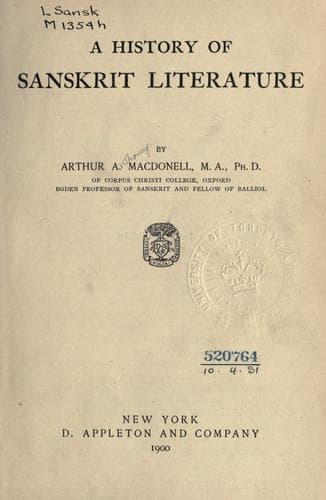
A History of Sanskrit LiteratureMacdonell, Arthur Anthony
History
A History of Sanskrit Literature
Macdonell, Arthur Anthony
Sanskrit literature -- History and criticism
Coming to later centuries, we find indications that the Neo-Platonist
philosophy may have been influenced by the Sankhya system, which
flourished in the first centuries of our era, and could easily have
become known at Alexandria owing to the lively intercourse between
that city and India at the time. From this source Plotinus (204-269
A.D.), chief of the Neo-Platonists, may have derived his doctrine
that soul is free from suffering, which belongs only to matter,
his identification of soul with light, and his illustrative use
of the mirror, in which the reflections of objects appear, for the
purpose of explaining the phenomena of consciousness. The influence
of the Yoga system on Plotinus is suggested by his requirement that
man should renounce the world of sense and strive after truth by
contemplation. Connection with Sankhya ideas is still more likely in
the case of Plotinus's most eminent pupil, Porphyry (232-304 A.D.),
who lays particular stress on the difference between soul and matter,
on the omnipresence of soul when freed from the bonds of matter, and
on the doctrine that the world has no beginning. It is also noteworthy
that he rejects sacrifice and prohibits the killing of animals.
The influence of Indian philosophy on Christian Gnosticism in the
second and third centuries seems at any rate undoubted. The Gnostic
doctrine of the opposition between soul and matter, of the personal
existence of intellect, will, and so forth, the identification of soul
and light, are derived from the Sankhya system. The division, peculiar
to several Gnostics, of men into the three classes of pneumatikoi,
psychikoi, and hylikoi, is also based on the Sankhya doctrine of the
three gunas. Again, Bardesanes, a Gnostic of the Syrian school, who
obtained information about India from Indian philosophers, assumed
the existence of a subtle ethereal body which is identical with the
linga-çarira of the Sankhya system. Finally, the many heavens of
the Gnostics are evidently derived from the fantastic cosmogony of
later Buddhism.
With regard to the present century, the influence of Indian thought
on the pessimistic philosophy of Schopenhauer and Von Hartmann is
well known. How great an impression the Upanishads produced on the
former, even in a second-hand Latin translation, may be inferred from
his writing that they were his consolation in life and would be so
in death.
Public-domain text, read in full here on John Shaqi.
Reviews
Reviews
No reviews yet
Be the first to share your thoughts on this work.
Elsewhere in the archive
Join the Discussion
Join the discussion
Sign in to leave a comment or review.
Sign InorCreate an account