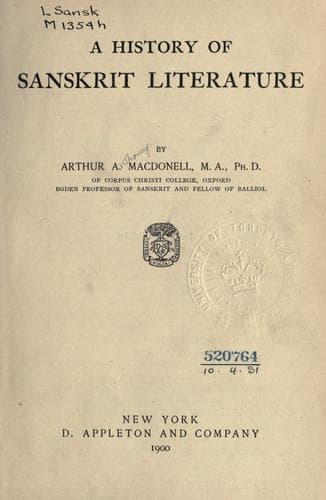
A History of Sanskrit LiteratureMacdonell, Arthur Anthony
History
A History of Sanskrit Literature
Macdonell, Arthur Anthony
Sanskrit literature -- History and criticism
In Science, too, the debt of Europe to India has been
considerable. There is, in the first place, the great fact that the
Indians invented the numerical figures used all over the world. The
influence which the decimal system of reckoning dependent on those
figures has had not only on mathematics, but on the progress of
civilisation in general, can hardly be over-estimated. During
the eighth and ninth centuries the Indians became the teachers in
arithmetic and algebra of the Arabs, and through them of the nations
of the West. Thus, though we call the latter science by an Arabic name,
it is a gift we owe to India.
In Geometry the points of contact between the Çulva Sutras and the
work of the Greeks are so considerable, that, according to Cantor,
the historian of mathematics, borrowing must have taken place on one
side or the other. In the opinion of that authority, the Çulva Sutras
were influenced by the Alexandrian geometry of Hero (215 B.C.), which,
he thinks, came to India after 100 B.C. The Çulva Sutras are, however,
probably far earlier than that date, for they form an integral portion
of the Çrauta Sutras, and their geometry is a part of the Brahmanical
theology, having taken its rise in India from practical motives as much
as the science of grammar. The prose parts of the Yajurvedas and the
Brahmanas constantly speak of the arrangement of the sacrificial ground
and the construction of altars according to very strict rules, the
slightest deviation from which might cause the greatest disaster. It
is not likely that the exclusive Brahmans should have been willing to
borrow anything closely connected with their religion from foreigners.
Of Astronomy the ancient Indians had but slight independent
knowledge. It is probable that they derived their early acquaintance
with the twenty-eight divisions of the moon's orbit from the Chaldeans
through their commercial relations with the Phoenicians. Indian
astronomy did not really begin to flourish till it was affected by that
of Greece; it is indeed the one science in which undoubtedly strong
Greek influence can be proved. The debt which the native astronomers
always acknowledge they owe to the Yavanas is sufficiently obvious
from the numerous Greek terms in Indian astronomical writings. Thus,
in Varaha Mihira's Hora-çastra the signs of the zodiac are enumerated
either by Sanskrit names translated from the Greek or by the original
Greek names, as Ara for Ares, Heli for Helios, Jyau for Zeus. Many
technical terms were directly borrowed from Greek works, as kendra
for kentron, jamitra for diametron. Some of the very names of the
oldest astronomical treatises of the Indians indicate their Western
origin. Thus the Romaka-siddhanta means the "Roman manual." The title
of Varaha Mihira's Hora-çastra contains the Greek word hora.
Public-domain text, read in full here on John Shaqi.
Reviews
Reviews
No reviews yet
Be the first to share your thoughts on this work.
Elsewhere in the archive
Join the Discussion
Join the discussion
Sign in to leave a comment or review.
Sign InorCreate an account