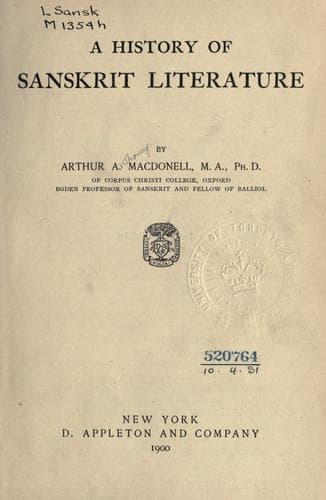
A History of Sanskrit LiteratureMacdonell, Arthur Anthony
History
A History of Sanskrit Literature
Macdonell, Arthur Anthony
Sanskrit literature -- History and criticism
In a few respects, however, the Indians independently advanced
astronomical science further than the Greeks themselves, and at a later
period they in their turn influenced the West even in astronomy. For
in the eighth and ninth centuries they became the teachers of the
Arabs in this science also. The siddhantas (Arabic Sind Hind), the
writings of Aryabhata (called Arjehir), and the Ahargana (Arkand),
attributed to Brahmagupta, were translated or adapted by the Arabs,
and Khalifs of Bagdad repeatedly summoned Indian astronomers to their
court to supervise this work. Through the Arabs, Indian astronomy
then migrated to Europe, which in this case only received back in a
roundabout way what it had given long before. Thus the Sanskrit word
uchcha, "apex of a planet's orbit," was borrowed in the form of aux
(gen. aug-is) in Latin translations of Arabic astronomers.
After Bhaskara (twelfth century), Hindu astronomy, ceasing to make
further progress, became once more merged in the astrology from which
it had sprung. It was now the turn of the Arabs, and, by a strange
inversion of things, an Arabic writer of the ninth century who had
written on Indian astronomy and arithmetic, in this period became an
object of study to the Hindus. The old Greek terms remained, but new
Arabic ones were added as the necessity for them arose.
The question as to whether Indian Medical Science in its earlier
period was affected by that of the Greeks cannot yet be answered with
certainty, the two systems not having hitherto been compared with
sufficient care. Recently, however, some close parallels have been
discovered between the works of Hippocrates and Charaka (according
to a Chinese authority, the official physician of King Kanishka),
which render Greek influence before the beginning of our era likely.
On the other hand, the effect of Hindu medical science upon the Arabs
after about 700 A.D. was considerable, for the Khalifs of Bagdad caused
several books on the subject to be translated. The works of Charaka
and Suçruta (probably not later than the fourth century A.D.) were
rendered into Arabic at the close of the eighth century, and are
quoted as authorities by the celebrated Arabic physician Al-Razi,
who died in 932 A.D. Arabic medicine in its turn became the chief
authority, down to the seventeenth century, of European physicians. By
the latter Indian medical authors must have been thought highly of,
for Charaka is repeatedly mentioned in the Latin translations of the
Arab writers Avicenna (Ibn Sina), Rhazes (Al-Razi), and Serapion (Ibn
Sarafyun). In modern days European surgery has borrowed the operation
of rhinoplasty, or the formation of artificial noses, from India,
where Englishmen became acquainted with the art in the last century.
Public-domain text, read in full here on John Shaqi.
Reviews
Reviews
No reviews yet
Be the first to share your thoughts on this work.
Elsewhere in the archive
Join the Discussion
Join the discussion
Sign in to leave a comment or review.
Sign InorCreate an account