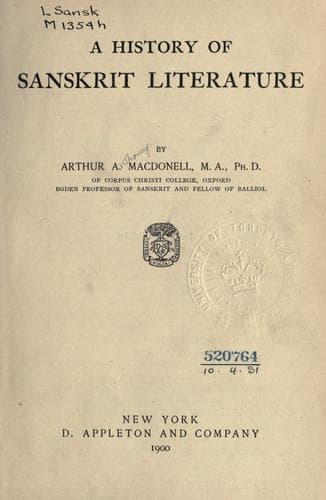
A History of Sanskrit LiteratureMacdonell, Arthur Anthony
History
A History of Sanskrit Literature
Macdonell, Arthur Anthony
Sanskrit literature -- History and criticism
We have already seen that the discovery of the Sanskrit language
and literature led, in the present century, to the foundation
of the two new sciences of Comparative Mythology and Comparative
Philology. Through the latter it has even affected the practical
school-teaching of the classical languages in Europe. The interest in
Buddhism has already produced an immense literature in Europe. Some
of the finest lyrics of Heine, and works like Sir Edwin Arnold's
Light of Asia, to mention only a few instances, have drawn their
inspiration from Sanskrit poetry. The intellectual debt of Europe to
Sanskrit literature has thus been undeniably great; it may perhaps
become greater still in the years that are to come.
APPENDIX ON TECHNICAL LITERATURE
LAW.
On Sanskrit legal literature in general, consult the very valuable
work of Jolly, Recht und Sitte, in Bühler's Encyclopædia, 1896
(complete bibliography). There are several secondary Dharma Sutras of
the post-Vedic period. The most important of these is the Vaishnava
Dharma Çastra or Vishnu Smriti (closely connected with the Kathaka
Grihya Sutra), not earlier than 200 A.D. in its final redaction (ed. by
Jolly, Calcutta, 1881, trans. by him in the Sacred Books of the East,
Oxford, 1880). The regular post-Vedic lawbooks are metrical (mostly
in çlokas). They are much wider in scope than the Dharma Sutras, which
are limited to matters connected with religion. The most important and
earliest of the metrical Smritis is the Manava Dharma Çastra, or Code
of Manu, not improbably based on a Manava Dharma Sutra. It is closely
connected with the Mahabharata, of which three books alone (iii.,
xii., xvi.) contain as many as 260 of its 2684 çlokas. It probably
assumed its present shape not much later than 200 A.D. It was ed. by
Jolly, London, 1887; trans. by Bühler, with valuable introd., in the
Sacred Books, Oxford, 1886; also trans. by Burnell (ed. by Hopkins),
London, 1884; text ed., with seven comm., by Mandlik, Bombay, 1886;
text, with Kulluka's comm., Bombay, 1888, better than Nirn. Sag. Pr.,
ed. 1887. Next comes the Yajnavalkya Dharma Çastra, which is much
more concise (1009 çlokas). It was probably based on a Dharma Sutra
of the White Yajurveda; its third section resembles the Paraskara
Grihya Sutra, but it is unmistakably connected with the Manava Grihya
Sutra of the Black Yajurveda. Its approximate date seems to be about
350 A.D. Its author probably belonged to Mithila, capital of Videha
(Tirhut). Yajnavalkya, ed. and trans, by Stenzler, Berlin, 1849;
with comm. Mitakshara, 3rd ed., Bombay, 1892. The Narada Smriti is
the first to limit dharma to law in the strict sense. It contains
more than 12,000 çlokas, and appears to have been founded chiefly on
Manu. Bana mentions a Naradiya Dharma Çastra, and Narada was annotated
by one of the earliest legal commentators in the eighth century. His
date is probably about 500 A.D. Narada, ed. by Jolly, Calcutta, 1885,
trans. by him in Sacred Books, vol. xxxiii.
Public-domain text, read in full here on John Shaqi.
Reviews
Reviews
No reviews yet
Be the first to share your thoughts on this work.
Elsewhere in the archive
Join the Discussion
Join the discussion
Sign in to leave a comment or review.
Sign InorCreate an account