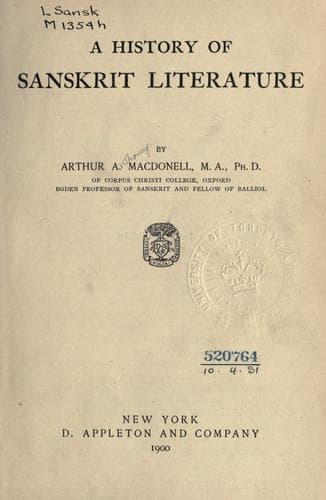
A History of Sanskrit LiteratureMacdonell, Arthur Anthony
History
A History of Sanskrit Literature
Macdonell, Arthur Anthony
Sanskrit literature -- History and criticism
1889. A late lawbook is the
Paraçara Smriti (anterior to 1300 A.D.), ed. in Bombay Sansk. Series,
1893; trans. Bibl. Ind., 1887. The second stage of post-Vedic legal
literature is formed by the commentaries. The oldest one preserved
is that of Medhatithi on Manu; he dates from about 900 A.D. The most
famous comm. on Manu is that of Kulluka-bhatta, composed at Benares
in the fifteenth century, but it is nothing more than a plagiarism
of Govindaraja, a commentator of the twelfth century. The most
celebrated comm. on Yajnavalkya is the Mitakshara of Vijnaneçvara,
composed about 1100 A.D. It early attained to the position of a
standard work, not only in the Dekhan, but even in Benares and a
great part of Northern India. In the present century it acquired the
greatest importance in the practice of the Anglo-Indian law-courts
through Colebrooke's translation of the section which it contains on
the law of inheritance. From about 1000 A.D. onwards, an innumerable
multitude of legal compendia, called Dharma-nibandhas, was produced
in India. The most imposing of them is the voluminous work in five
parts entitled Chaturvarga-chintamani, composed by Hemadri about
1300 A.D. It hardly treats of law at all, but is a perfect mine of
interesting quotations from the Smritis and the Puranas; it has been
edited in the Bibl. Ind. The Dharmaratna of Jimutavahana (probably
fifteenth century) may here be mentioned, because part of it is the
famous treatise on the law of inheritance entitled Dayabhaga, which is
the chief work of the Bengal School on the subject, and was translated
by Colebrooke. It should be noted that the Indian Smritis are not on
the same footing as the lawbooks of other nations, but are works of
private individuals; they were also written by Brahmans for Brahmans,
whose caste pretensions they consequently exaggerate. It is therefore
important to check their statements by outside evidence.
HISTORY.
No work of a directly historical character is met with in
Sanskrit literature till after the Muhammadan conquest. This is
the Rajatarangini, or "River of Kings," a chronicle of the kings of
Kashmir, begun by its author, Kalhana, in 1148 A.D. It contains nearly
8000 çlokas. The early part of the work is legendary in character. The
poet does not become historical till he approaches his own times. This
work (ed. M. A. Stein, Bombay, 1892; trans, by Y. C. Datta, Calc.,
1898) is of considerable value for the archæology and chronology
of Kashmir.
GRAMMAR.
Public-domain text, read in full here on John Shaqi.
Reviews
Reviews
No reviews yet
Be the first to share your thoughts on this work.
Elsewhere in the archive
Join the Discussion
Join the discussion
Sign in to leave a comment or review.
Sign InorCreate an account