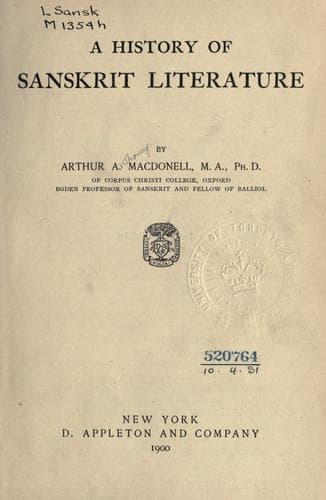
A History of Sanskrit LiteratureMacdonell, Arthur Anthony
History
A History of Sanskrit Literature
Macdonell, Arthur Anthony
Sanskrit literature -- History and criticism
Kirste, Vienna, 1895). The Katantra of
Çarvavarman (ed. Eggeling, Bibl. Ind.) seems to have been the most
influential of the later grammars. Vararuchi's Prakrita-prakaça is a
Prakrit grammar (ed. by Cowell, 2nd ed., 1868). The Mugdhabodha (13th
cent.) of Vopadeva is the Sanskrit grammar chiefly used in Bengal. The
Phit Sutra (later than Patanjali) gives rules for the accentuation of
nouns (ed. Kielhorn, 1866); Hemachandra's Linganuçasana is a treatise
on gender (ed. Franke, Göttingen, 1886). Among European grammars
that of Whitney was the first to attempt a historical treatment
of the Vedic and Sanskrit language. The first grammar treating
Sanskrit from the comparative point of view is the excellent work
of Wackernagel, of which, however, only the first part (phonology)
has yet appeared. The present writer's abridgment (London, 1886)
of Max Müller's Sanskrit Grammar is a practical work for the use of
beginners of Classical Sanskrit.
LEXICOGRAPHY.
Zachariæ in Die indischen Wörterbücher (in Bühler's Encyclopædia,
1897) deals with the subject as a whole (complete bibliography). The
Sanskrit dictionaries or koças are collections of rare words
or significations for the use of poets. They are all versified;
alphabetical order is entirely absent in the synonymous and only
incipient in the homonymous class. The Amarakoça (ed. with Maheçvara's
comm., Bombay), occupies the same dominant position in lexicography
as Panini in grammar, not improbably composed about 500 A.D. A
supplement to it is the Trikanda-çesha by Purushottamadeva (perhaps
as late as 1300 A.D.). Çaçvata's Anekartha-samuchchaya (ed. Zachariæ,
1882) is possibly older than Amara. Halayudha's Abhidhanaratnamala
dates from about 950 A.D. (ed. Aufrecht, London, 1861). About a
century later is Yadavaprakaça's Vaijayanti (ed. Oppert, Madras,
1893). The Viçvaprakaça of Maheçvara Kavi dates from 1111 A.D. The
Mankha-koça (ed. Zachariæ, Bombay, 1897) was composed in Kashmir about
1150 A.D. Hemachandra (1088-1172 A.D.) composed four dictionaries:
Abhidhana-chintamani, synonyms (ed. Böhtlingk and Rieu, St. Petersburg,
1847); Anekartha-samgraha, homonyms (ed. Zachariæ, Vienna, 1893);
Deçinamamala, a Prakrit dictionary (ed. Pischel, Bombay, 1880);
and Nighantu-çesha, a botanical glossary, which forms a supplement
to his synonymous koça.
POETICS.
Public-domain text, read in full here on John Shaqi.
Reviews
Reviews
No reviews yet
Be the first to share your thoughts on this work.
Elsewhere in the archive
Join the Discussion
Join the discussion
Sign in to leave a comment or review.
Sign InorCreate an account