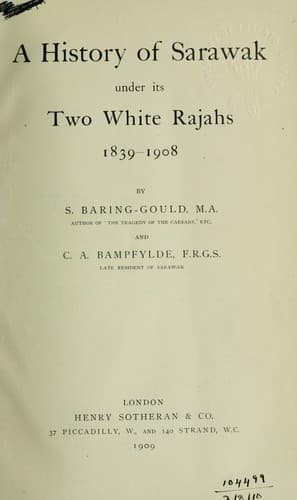
A History of Sarawak under Its Two White Rajahs 1839-1908Baring-Gould, S. (Sabine)
History
A History of Sarawak under Its Two White Rajahs 1839-1908
Baring-Gould, S. (Sabine)
Charles, Rajah of Sarawak, 1829-1917; James, Rajah of Sarawak, 1803-1868; Sarawak (Malaysia) -- History
As it gathered strength the Sam-Tiau-Kiau Hueh became contumacious and
insolent. As early as the close of 1850 it had brought itself
conspicuously to the attention of the Rajah, and the principal men were
warned to desist in time. This warning was unheeded, and a little later
it was discovered that members were being enrolled by persuasion and
threats, and that an agent of the Triad Society had come over from
Singapore to further its objects. This man, Kah Yun, was arrested and
sentenced to death, and others were fined and flogged. In 1852, the
Chinese in Upper Sarawak, who had more than once before been turbulent
and rebellious, openly resisted a Government officer, and prevented him
from arresting a criminal, a member of the Hueh. The Tuan Muda was sent
to the spot with a force, but, though well armed, the Chinese did not
then feel themselves strong enough to resist, and offered the most
humble obeisance, delivering up the culprit. They were then ordered to
build a fort at Belidah, below Siniawan, to equip it with arms and
ammunition, and to pay the wages of the fortmen. The fort, which was to
be a check on the Chinese, was built, and placed in charge of Sherip
Matusain, with a small garrison of Malays. The Chinese had been steadily
collecting arms and ammunition for some time past, and they were now
ordered to deliver up a hundred muskets, but the demand was afterwards
relinquished. This was a mistake, as they had no need of firearms for
their protection, living as they did amongst the peaceable Land Dayaks,
and the Tuan Muda was rightly of opinion that they had not been
sufficiently humbled, nor their power sufficiently weakened. To the
Hueh, however, the lesson was useful—it showed them the strength of the
Government, and taught them that submission would be wise until they
were better prepared.
In Sarawak in 1857 there were about 4000 of these yellow men, located
mainly in the mining district. There were numerous settlements over the
frontier in the territories of the Sultan of Sambas, where also the
people were engaged on the gold mines, and the Hueh could rely upon
their active aid.
A good deal of smuggling of opium had been in progress, and evidence was
obtained that convicted the Kongsi of gold-miners at Bau of having been
engaged in this illicit trade; whereupon it was fined £150, a small sum
considering the amount that the revenue had been defrauded by their
means. This fine was imposed a month only before the outbreak occurred;
it was paid, and the Hueh feigned submission.
The Sultan of Sambas had long been jealous of the growing prosperity of
Sarawak, and of the contrast afforded to his own misrule by the liberal
and good government there. Moreover, numerous Land-Dayaks from Sambas
had moved into the Rajah's territories for the sake of the protection
there afforded, which they could not obtain under the Sultan. He was
accordingly willing to encourage any attempt made to overthrow the
government of the Rajah.
Public-domain text, read in full here on John Shaqi.
Reviews
Reviews
No reviews yet
Be the first to share your thoughts on this work.
Elsewhere in the archive
Join the Discussion
Join the discussion
Sign in to leave a comment or review.
Sign InorCreate an account