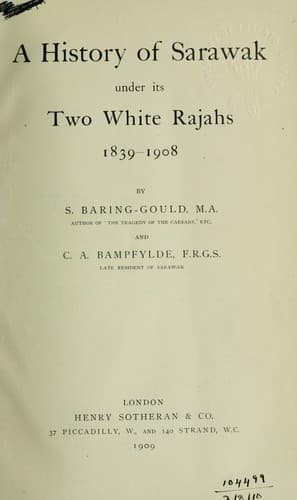
A History of Sarawak under Its Two White Rajahs 1839-1908Baring-Gould, S. (Sabine)
History
A History of Sarawak under Its Two White Rajahs 1839-1908
Baring-Gould, S. (Sabine)
Charles, Rajah of Sarawak, 1829-1917; James, Rajah of Sarawak, 1803-1868; Sarawak (Malaysia) -- History
The whole of the Rajah's private capital had been long ago exhausted,
and how were the ruins to be cleared away and the Government buildings
to be rebuilt? how were the servants of the State to be paid?
Nevertheless the Rajah and his staff faced their difficulties with
courage and confidence; but, deserted by the British Government, he was
sorely tempted to appeal to that of another power. Happily, after a
period of discouragement and resentment, he resolved to face his
difficulties, relying only on himself and his few English assistants. He
had on his right and left hand two stout and able men, his two nephews.
Within a short period many of the Chinese refugees, particularly those
of the agricultural class, returned and rebuilt their old homes.
Gradually their numbers were added to by others from over the border,
from the Straits, and from China, until in time Upper Sarawak recovered
its former prosperity. The severe lesson they had learnt, which had
taught them how powerless they were to cope with the forces at the call
of the Government, that were not represented merely by a handful of
fortmen and policemen as they had blindly imagined, did not, however,
deter them from forming another Hueh, which decreased and increased in
strength in proportion to the number of people in the district. But the
power of the Government has been steadily growing, and what chance the
Hueh may have ever hoped to obtain of successfully opposing it has long
ago vanished. Dangerous and mischievous, however, these secret societies
can still be, unless vigilantly watched and swiftly suppressed, and the
Chinese population in Upper Sarawak has since increased five-fold.
For years the Bau Hueh remained dormant, though it had a perfect
organisation, but in 1869 it raised its hand in opposition to the
Government, and barbarously murdered an informer. Mr. Crookshank, who
was administering the Government in the absence of the present Rajah,
took prompt and energetic measures, and all the headmen of the Hueh were
arrested. They were condemned to long terms of imprisonment and to be
flogged. When their terms had expired they were banished the country
under a penalty of death should they return; but the Hueh in Dutch
Borneo, of which this was a branch, immediately re-organised the Society
and appointed other office-bearers. Unfortunately the register and
records of this Hueh could not be found. They had been cleverly
concealed in the double-planked floor of a bed-place which had been
overturned in the search.
Public-domain text, read in full here on John Shaqi.
Reviews
Reviews
No reviews yet
Be the first to share your thoughts on this work.
Elsewhere in the archive
Join the Discussion
Join the discussion
Sign in to leave a comment or review.
Sign InorCreate an account