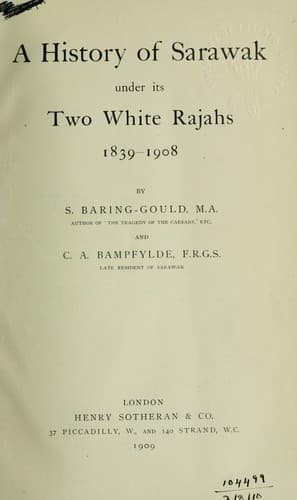
A History of Sarawak under Its Two White Rajahs 1839-1908Baring-Gould, S. (Sabine)
History
A History of Sarawak under Its Two White Rajahs 1839-1908
Baring-Gould, S. (Sabine)
Charles, Rajah of Sarawak, 1829-1917; James, Rajah of Sarawak, 1803-1868; Sarawak (Malaysia) -- History
A testimonial to the Rajah had also been raised by public subscription
"as a simple, earnest, and affectionate testimony of friends to a noble
character and disinterested services—services which, instead of
enriching, had left their author broken by illness and weariness of
heart, with threatening poverty."[253] With a portion of this fund he
purchased Burrator, a small estate in the parish of Sheepstor, on the
fringe of Dartmoor, in Devon. It was then very much out of the world,
having no station nearer than Plymouth, some miles off, and the
intervening roads were steep, narrow, and bad. The situation is
singularly picturesque; a moorland village, with a church of granite
under the bold tor that gives its name to the place. Its wildness and
seclusion charmed him, and there he settled in June, 1859, "trusting to
live in retirement, in peace; but there is no peace for me with Sarawak
in such a state," for the news of the Malay conspiracies caused him
further distress of mind, and he resolved to return to Sarawak.
-----
Footnote 224:
In addition to their other duties in the capital. See list of titles,
p. xi.
Footnote 225:
See chap. iii. p. 77, for particulars of these Datus.
Footnote 226:
The Datu Patinggi Abdul Rahman was the rightful Malay chief of the
Rejang, and the Sultan's representative. Sherip Masahor had originally
settled at Igan, which place, with the surrounding district, belonged
to him. At Serikei he was an interloper. He usurped authority wherever
he could do so, and the Sultan, whose power in the Rejang was but a
shadow, was constrained to put up with the Sherip's pretensions.
Footnote 227:
This is incorrect. On more than one occasion he greatly distinguished
himself fighting for the Government, especially at the time of the
Chinese insurrection, but he died a natural death.
Footnote 228:
An error—he was the Bandar's brother-in-law.
Footnote 229:
He did not change his title. There has been no Datu Patinggi since.
Footnote 230:
Haji Bua Hasan, who afterwards became Datu Bandar (_vide_ Chap. III.
p. 77). It was not until 1860 that he was raised to the rank of Datu
under the title of the Datu Imaum.
Footnote 231:
Public-domain text, read in full here on John Shaqi.
Reviews
Reviews
No reviews yet
Be the first to share your thoughts on this work.
Elsewhere in the archive
Join the Discussion
Join the discussion
Sign in to leave a comment or review.
Sign InorCreate an account