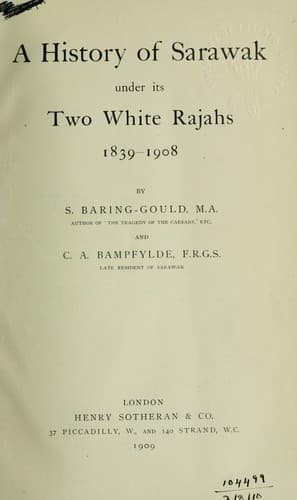
A History of Sarawak under Its Two White Rajahs 1839-1908Baring-Gould, S. (Sabine)
History
A History of Sarawak under Its Two White Rajahs 1839-1908
Baring-Gould, S. (Sabine)
Charles, Rajah of Sarawak, 1829-1917; James, Rajah of Sarawak, 1803-1868; Sarawak (Malaysia) -- History
The result is that the number of slaves in the territory is steadily
decreasing. Some of the Malays have been known to emancipate their
slaves at their death. Those who are now nominally slaves are
treated so well by their masters that they are probably happier and
better off than they would be as free men.
One great cause for the reduction in the number of slaves was that,
knowing their masters no longer had power to drive them, and were bound
to support them, whether they worked or not, they became lazy and
unprofitable to their owners, who eventually found paid labour to be far
cheaper, and were only too glad to be rid of them.
These regulations gave the death-blow to slavery. It now practically
remained to the slaves themselves to choose whether they should change
their condition or not; for energy on the part of a slave would enable
him to procure the price of his freedom, as well as that of his wife and
children, and that could no longer be arbitrarily fixed or refused by
his owner; or by contracting his labour he could obtain an advance for
this purpose. By degrees many availed themselves of this advantage,
though others preferred to remain in a state of dependency. They were
well provided for, there was no necessity to work too hard, and proper
treatment was secured to them. Thus it came to pass that many owners
lost their diligent slaves, and were left with the lazy and useless
ones, who became an expensive nuisance. Their wives and children,
however, remained slaves, as did those of men too infirm to work, but of
these, too, boys freed themselves as they grew up, and girls by
contracting marriages with freemen, and these could free their parents.
But the Rajah was desirous of abolishing an institution that, though it
was becoming one in name only, still remained a blot upon the country,
and in this he had the support of the Malay chiefs, which many showed in
a practical manner by publicly and unconditionally manumitting all their
slaves. Having before prepared the minds of the people for the great
social change he wished to effect by bringing before the members of the
General Council a proposal to abolish slavery, in 1883 he brought
forward a bill for the gradual manumission of the slaves during the next
five years, and for the abolition of slavery at the end of that period.
But it became unnecessary to proceed to an enactment, for in 1886
domestic slavery had practically become a thing of the past, and at a
meeting of the Council in that year the Rajah withdrew the bill.
Public-domain text, read in full here on John Shaqi.
Reviews
Reviews
No reviews yet
Be the first to share your thoughts on this work.
Elsewhere in the archive
Join the Discussion
Join the discussion
Sign in to leave a comment or review.
Sign InorCreate an account