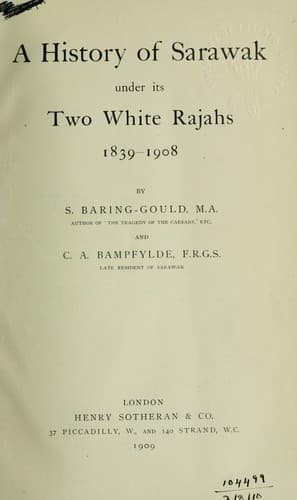
A History of Sarawak under Its Two White Rajahs 1839-1908Baring-Gould, S. (Sabine)
History
A History of Sarawak under Its Two White Rajahs 1839-1908
Baring-Gould, S. (Sabine)
Charles, Rajah of Sarawak, 1829-1917; James, Rajah of Sarawak, 1803-1868; Sarawak (Malaysia) -- History
As to the relations with Bruni, we shall deal with them in a special
chapter. These relations, and those with the Netherlands Government,
comprise the whole of Sarawak foreign policy, and the latter have of
late years been conducted in a friendly spirit of co-operation in the
mutual interests of the two countries, without undue and restrictive
formality and red-tapeism—a marked contrast to the relations with
Singapore, which has ever been jealous of Sarawak.
The relations with the Dutch had not, however, always been friendly, for
on two occasions they had seized Sarawak trading prahus on the idle
pretext of these being pirates. The second time was as late as 1865, and
then two Sarawak and a Bruni prahu were seized in company by a Dutch
gunboat and towed into Sinkawang, where their crew were placed in prison
in irons, and the vessels and cargoes confiscated. This drew a strong
protest from the Sarawak Government, and after some detention vessels
and crews were released, but without considerable portions of their
cargoes. Heavy damages were claimed, but never paid, though the seizure
was admitted to be wrongful.
This was a poor return for the relief Sarawak had afforded the Dutch
coast, both from the ravages of the Dayaks of Saribas and Sekrang, and
the pirates from the north. Before the action off Bintulu in 1862, the
Dutch had been unable effectually to protect their own coasts, the many
captives from Dutch Borneo then rescued being a sufficient proof of
this, but after that action the pirates did not venture to pass Sarawak
again, and the north-western and western coasts were freed from their
visits. The action of the Dutch in seizing these prahus was the severest
blow Sarawak trade had suffered for many years; the fast-sailing prahus
might out-sail the pirates, or the well-armed ones beat them off, but
from men-of-war steamers there was no escape.
The Rajah has from his accession kept a strict supervision over all,
even the smallest details of revenue and expenditure; all accounts of
the Treasury and out-stations are submitted to him monthly, and no extra
expenses beyond those provided for by his orders may be incurred by any
department or in any out-station without his express sanction. His
guiding principle has always been the strictest economy within
limitations necessary to ensure efficiency. Upon his accession the
public debt amounted to about £15,000, a considerable sum, with a
revenue of only little over $100,000; this was exclusive of what had
been sunk by the late Rajah—the whole of his fortune, which Sir Spenser
St. John is wrong in saying stands to the credit of the Brooke family in
the Treasury. In 1870 the revenue was $122,842, in 1907, $1,441,195,
with a large surplus, and no public debt.
Public-domain text, read in full here on John Shaqi.
Reviews
Reviews
No reviews yet
Be the first to share your thoughts on this work.
Elsewhere in the archive
Join the Discussion
Join the discussion
Sign in to leave a comment or review.
Sign InorCreate an account