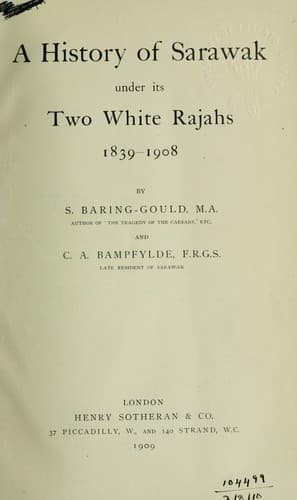
A History of Sarawak under Its Two White Rajahs 1839-1908Baring-Gould, S. (Sabine)
History
A History of Sarawak under Its Two White Rajahs 1839-1908
Baring-Gould, S. (Sabine)
Charles, Rajah of Sarawak, 1829-1917; James, Rajah of Sarawak, 1803-1868; Sarawak (Malaysia) -- History
In April, 1872, the Rajah, accompanied by a staff of English and Malay
officers, visited Bruni in the Government steamers _Heartsease_ and
_Royalist_. It was perhaps not unnatural that this visit was at first
regarded with suspicion as being in the form of a demonstration against
Bruni, to back unheeded protests against the maltreatment of Sarawak
subjects, and the nonfulfilment of treaty engagements. But this
impression was soon dispelled, and the Rajah was received by the Sultan,
"a fat, kindly-faced old man of some eighty years of age," with
cordiality and honour. The Rajah's main object in visiting Bruni was to
obtain an effective guarantee that his subjects trading in Bruni
territory should not be molested and unwarrantably interfered with. A
treaty conceding all that the Rajah asked for was accordingly drawn up
and ratified by the Sultan, and was satisfactory enough on paper. The
Sultan solemnly undertook the redressing of injuries, guaranteed
protection to traders, and the imposition of fair and moderate customs
duties only.
But this treaty, owing to the Sultan being powerless to enforce its
provisions outside the capital, soon became worse than useless; for,
relying on it being observed, Sarawak traders again ventured into the
Bruni ports, only to meet with the same treatment as before. The
extortion of outrageous customs dues went on as formerly. The Bruni
nobles, "the most useless race that ever encumbered the earth,"[309] set
themselves deliberately to frustrate every object aimed at in the
treaty, and, so that they might keep the trade with its enormous profits
to themselves, they plundered, and even killed those who ventured to
compete with them. But their day was not to last for ever. The Kayans,
driven to exasperation by the heavy fines and other extortions imposed
upon them, eventually rose against these tyrants, and drove them out.
[Illustration:
THE SULTAN'S PALACE.]
Next to the Rejang, the Baram is the largest river that flows into the
sea on that coast. In its basin are congregated large populations of
Kayans and Kenyahs.
In 1872, the Rajah, accompanied by the Ranee, visited this river to
ascertain for himself how far it would be safe for Sarawak subjects to
trade there. He steamed a long way up the river, and was everywhere well
received by the natives, who had been much depressed by extortion and
were eager to be relieved from the thraldom in which they were held by
Bruni. There had been no encouragement given to them to work the jungle
produce in which their country was rich, except to purchase necessaries,
and these could be obtained through their Bruni masters alone, and that
at exorbitant prices. There was in consequence little trade at the time.
But what this river is capable of producing may be shown by its trade
returns at present. The exports, entirely of jungle produce, after the
district had been for twenty years under Sarawak, amounted in 1906 to
$272,223.
Public-domain text, read in full here on John Shaqi.
Reviews
Reviews
No reviews yet
Be the first to share your thoughts on this work.
Elsewhere in the archive
Join the Discussion
Join the discussion
Sign in to leave a comment or review.
Sign InorCreate an account