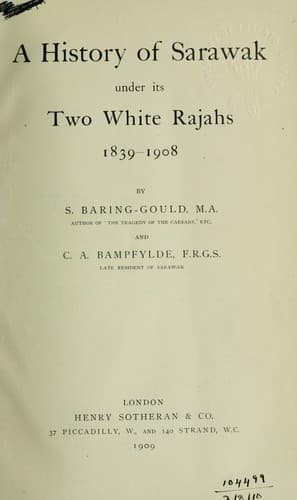
A History of Sarawak under Its Two White Rajahs 1839-1908Baring-Gould, S. (Sabine)
History
A History of Sarawak under Its Two White Rajahs 1839-1908
Baring-Gould, S. (Sabine)
Charles, Rajah of Sarawak, 1829-1917; James, Rajah of Sarawak, 1803-1868; Sarawak (Malaysia) -- History
Although the Sultan had no real authority over the Kayans and Kenyahs
there still existed among them a certain regard for him, and of this the
Bruni Government took advantage. These races had never been subdued by
the Sultans by force of arms. They never had voluntarily tendered
submission. The restraint exercised over them was due mainly to the fact
that the Brunis held the mouths of the rivers and consequently
controlled the trade, and that trade was one in the very necessaries of
existence. It was inevitable that the rulers of Bruni should resent, and
resist to the utmost, the opening of the rivers to Sarawak traders,
which would involve, as they well saw, the drying up of the source of
their wealth.
The natives on the Baram had an exaggerated opinion of the power of
Bruni, but this illusion was dispelled after a feeble attack made on the
Kayans in September, 1870, which resulted in ignominious failure. Still,
they were prepared to submit to such demands which, though extortionate,
custom had taught them to regard as the Sultan's due, and they could not
do without the imports, which they were precluded from obtaining
elsewhere and from others, than Bruni and the hands of pangirans. But
the rapacity of the pangirans became at last intolerable; and we will
here give two instances illustrative of the methods adopted by them,
which were connived at by the Sultan.
In 1873, a mixed party of Dayaks, Tanjongs, and Bukitans from the Rejang
river, working produce in the Baram, were attacked by the Kayans. Six
were killed and one escaped. The survivor stated that the party had been
treacherously attacked; but on the other hand the Kayans asserted that
the behaviour of the strangers had been so suspicious that they had
satisfied themselves that they were a head-hunting party. The Rajah
complained and demanded redress. The Sultan sent an agent in his small
steamer to impose a fine, which in itself was excessive. The agent
proceeded to the house of the chief of the lower Baram Kayans, although
these people had nothing to do with the killing of the subjects of the
Rajah, but it was as far up as he dared to venture, and levied the fine
upon them, demanding double the amount he had been instructed to impose,
the difference, of course, to go into his own pocket. The Rajah had
fixed the fine, but the Sultan had put on his price as well, so that he
might have his pickings out of the affair, and now his agent doubled
that sum. It was in vain for the chief to protest that neither he nor
his people had been concerned in the murders. The Sultan's agent
threatened the chief that if he did not pay, the Rajah would send
several men-of-war, that others would be despatched from Labuan, and
more from Bruni, and that all their country would be laid waste and
their villages burned. After a stormy interview, the chief succeeded in
beating the agent down to a fine amounting to $8000, just thirty times
more than the amount demanded by the Rajah as compensation to the
Public-domain text, read in full here on John Shaqi.
Reviews
Reviews
No reviews yet
Be the first to share your thoughts on this work.
Elsewhere in the archive
Join the Discussion
Join the discussion
Sign in to leave a comment or review.
Sign InorCreate an account