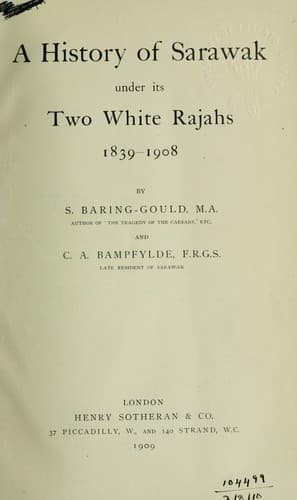
A History of Sarawak under Its Two White Rajahs 1839-1908Baring-Gould, S. (Sabine)
History
A History of Sarawak under Its Two White Rajahs 1839-1908
Baring-Gould, S. (Sabine)
Charles, Rajah of Sarawak, 1829-1917; James, Rajah of Sarawak, 1803-1868; Sarawak (Malaysia) -- History
relatives of those killed. And this fine the chief was constrained to
pay.
Upon the death of the Sultana, a commissioner was sent to Baram by the
Sultan to demand the customary aid towards the obsequies. A meeting of
all the chiefs was summoned by the commissioner, a haji, and, as it
happened, the late Mr. H. Brooke Low, who was then travelling in the
Baram, was present. The Sultan's mandate, requiring so much from each
man, was read and left with the chiefs, the haji not for a moment
suspecting that any one present could read it. Mr. Low, however, was
able to do so, and when it was shown to him he was shocked, though not
surprised, to discover that the haji had read into the mandate a
requirement for amounts more than double that demanded.
But the rebellion of the Kayans and the expulsion of the Brunis from
Baram ensued in the middle of 1874; the river was freed of its
oppressors, and the victorious Kayans menaced every settlement along the
coast from the Baram to Bintulu. The villages were deserted and the
Sultan was in despair, unable to reduce the Kayans, unable even to
protect the Malays. Not only could he draw no revenue thence, but he
dare not even ask for it. This prepared the way for the transfer of the
whole stretch of coast to Sarawak. So far as the Sultan was concerned he
was glad to commute the sovereignty of a district, from which little
before the revolt, and nothing after, could be squeezed by himself out
of the inhabitants, for a certain sum guaranteed to be paid to himself
annually.
To escape Bruni oppression, people were constantly migrating to Sarawak,
principally from the Semalajau, Niah, and Miri rivers, and in 1876 over
2000 came in. These poor people had to effect their escape by stealth,
and consequently had to abandon all their property. Shortly after this
upwards of 500 families of Kenyahs moved over into the Bintulu.
In accordance with the treaty with Great Britain of 1847 the Sultan was
debarred from ceding any territory to any foreign power without the
sanction of her Majesty's Government. This gave the British Government
the right, or rather the power, to prevent Sarawak acquiring the Baram,
and this it was prepared to do. As usual it proved obstructive, and
refused to sanction the transfer; it went so far as to express its
unwillingness to allow any territorial change to be made on the coast of
Bruni. This was insisted on again in 1876, though the Rajah wrote to the
Secretary for Foreign Affairs (March 20) "I may candidly state that a
most pernicious system of robbery and oppression is pursued by the
hirelings of the Bruni Government. It surely can scarcely be conceived
by her Majesty's Government that upholding the authority of the Bruni
Government is tantamount to supporting the cause of oppression and
misrule."
Public-domain text, read in full here on John Shaqi.
Reviews
Reviews
No reviews yet
Be the first to share your thoughts on this work.
Elsewhere in the archive
Join the Discussion
Join the discussion
Sign in to leave a comment or review.
Sign InorCreate an account