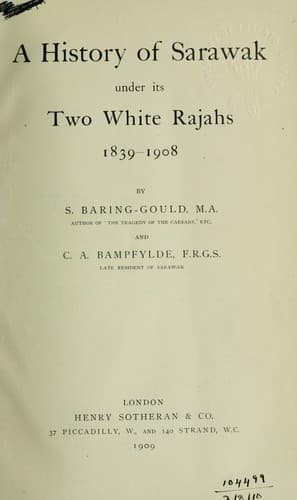
A History of Sarawak under Its Two White Rajahs 1839-1908Baring-Gould, S. (Sabine)
History
A History of Sarawak under Its Two White Rajahs 1839-1908
Baring-Gould, S. (Sabine)
Charles, Rajah of Sarawak, 1829-1917; James, Rajah of Sarawak, 1803-1868; Sarawak (Malaysia) -- History
If the reader will look at the map he will see that a peninsula or horn
runs out from Bruni, sheltering the bay against the winds and waves from
the north-west. Labuan is actually a continuation of the same, but the
belt of land has been broken through, leaving only Labuan and a few
little islands rising above the surface of the ocean. At the extreme
point of the promontory is a lighthouse erected by the Rajah. This
promontory goes by the name of Muara. The coal-beds that come to the
surface in Labuan, continue in Muara, and Mr. W. C. Cowie[319] had
obtained from the Sultan Mumin a concession of the coal-fields in Muara,
and all rights over this district were ceded to him in perpetuity by the
late Sultan in 1887. These rights confer complete and absolute
possession of all the lands in the district, with power to sell, impose
taxes, rents, and assessments, the possession of the revenue farms, with
power to create new farms of any description, and certain judicial
rights conjoined with power to inflict penalties.
This Muara district, the town in which was founded by Mr. Cowie, and
named by him Brooketon in honour of the Rajah, is the richest portion of
the small and shrunken territory now remaining to the Sultanate of
Bruni, and it remains to it, as may be seen, attached by a thread only.
It is not large, but it is of much importance, as it possesses a good
colliery and an excellent harbour. Previous to the opening of this
colliery the population, consisting of a few Kadayan peasants and Malay
fishermen, was small and scattered, and, in common with the lower
classes throughout the Sultanate, led a miserable existence under
misrule.
Mr. Cowie found that a much larger capital was needed to develop the
colliery than he possessed, without which the workings would be
unremunerative. Every year entailed increasing loss, and in 1888, two
years before the acquisition of the Limbang by the Rajah, he sold to him
all his rights in Muara.
Previous to the transfer, for want of capital, the mines had been worked
in a hand-to-mouth fashion by a few coolies under a manager with but
little experience, the output being confined to meeting the very limited
local demand in Labuan. There was practically no plant, and only a small
ricketty wharf, to which the surface coal was conveyed in buffalo-drawn
waggons over a roughly constructed line.
Public-domain text, read in full here on John Shaqi.
Reviews
Reviews
No reviews yet
Be the first to share your thoughts on this work.
Elsewhere in the archive
Join the Discussion
Join the discussion
Sign in to leave a comment or review.
Sign InorCreate an account