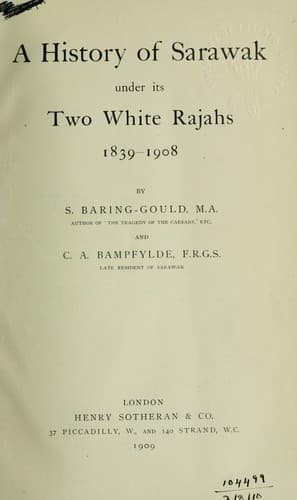
A History of Sarawak under Its Two White Rajahs 1839-1908Baring-Gould, S. (Sabine)
History
A History of Sarawak under Its Two White Rajahs 1839-1908
Baring-Gould, S. (Sabine)
Charles, Rajah of Sarawak, 1829-1917; James, Rajah of Sarawak, 1803-1868; Sarawak (Malaysia) -- History
Those who knew Brooketon in those days and know it now, can testify to
the great improvements that have been made by the Rajah's persistent
efforts. The greatest possible benefits have been conferred upon the
people by the establishment of a large and growing industry among them,
but it has been effected at a heavy financial loss. The colliery has
been placed under experienced managers; expensive, though necessary,
machinery, locomotives, a steam collier, lighters, etc., have been
purchased, extensive and solid wharves built, and a new line laid down.
The cost of these, with the many other preliminary expenses incidental
to the proper working of a large colliery, have been heavy, and so far
it has proved an unremunerative speculation. The colliery employs
hundreds of miners and workmen, and through it, indirectly, many people
gain a livelihood, and the thriving settlement of Brooketon is solely
dependent upon it. Law and order have been effectively maintained by the
Rajah at his own cost, though in the name and with the consent of the
Sultan. Although financial improvement may be remote, closing the mines
down would mean a loss of all these benefits to the people; the place
would revert to its former condition, and the population would be
dispersed. This consideration has induced the Rajah to continue working
the colliery, with the hope of ultimately lessening the losses, and the
remoter hope of ultimate success. To Brooketon we shall again refer.
In March, 1905, a chief named Lawai, who had been dignified by the
Sultan with the title of Orang Kaya Temanggong, with some 400 of his
numerous following, removed into the Limbang river from the Baram, in
defiance of Government orders. In former days these people had been the
most forward amongst those employed by the Bruni Government to molest
the Limbang people, and a short time previous to their removal to the
Limbang had killed three Kadayans in Bruni territory, who had incurred
displeasure in certain high quarters. After these murders had been
committed, Lawai had been favourably received by the Sultan at Bruni,
and this no doubt encouraged him openly to resist the Government. A
small force was despatched against him, and, taken by surprise, he was
captured.
The rendezvous of this expedition was off Muara island, at the entrance
to Bruni bay, and, as its object was kept a profound secret,
considerable uneasiness arose in the suspicious minds of those at Bruni,
who with good reason feared the displeasure of the Rajah. A secret
meeting of the leading pangirans and chiefs was held; at which it was
decided that should it be the Rajah's intention to sweep away their evil
government they would kill the Sultan and hand over the city to him.
Public-domain text, read in full here on John Shaqi.
Reviews
Reviews
No reviews yet
Be the first to share your thoughts on this work.
Elsewhere in the archive
Join the Discussion
Join the discussion
Sign in to leave a comment or review.
Sign InorCreate an account