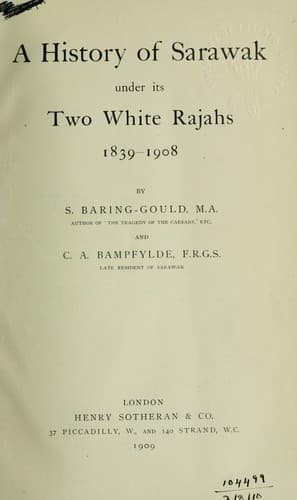
A History of Sarawak under Its Two White Rajahs 1839-1908Baring-Gould, S. (Sabine)
History
A History of Sarawak under Its Two White Rajahs 1839-1908
Baring-Gould, S. (Sabine)
Charles, Rajah of Sarawak, 1829-1917; James, Rajah of Sarawak, 1803-1868; Sarawak (Malaysia) -- History
With this exception, from the day that the Sarawak flag had been
hoisted, there have been no disturbances in the Limbang. But in the
neighbouring river, the Trusan, the perpetual petty feuds amongst the
Muruts, which led to isolated cases of murder, wounding, and
cattle-lifting, caused the Government considerable trouble. In 1900, it
became necessary to administer a severe lesson. Some Muruts living in
the far interior under their chief, Okong, aided by those of the Lawas,
not then under the Sarawak Government, having killed twenty-one Muruts
of the lower Trusan, an expedition, with which the Rajah Muda went, was
sent to punish them. This was so effectually done, that it resulted in
the people of the interior coming in from all quarters to renounce their
feuds; and since that Trusan has also been free from such troubles.
Commenting upon Bornean affairs, the _Singapore Free Press_ in August,
1900, remarked that: "Bruni, though independent, is in a state of
bankruptcy and decay, and would not be a desirable acquisition for any
one. Its revenues, such as they are, are all leased and sold, and those
who should benefit from them have long parted with their interests. The
aged Sultan, troubled with debts and worried by creditors, has given
powers to the most importunate in their claims, which action has
alienated the support of those hereditary chiefs who are entitled to
share with him the government of the country. These chiefs assume
semi-independence, and each goes his own way unchecked, a method which
tends to bring affairs of State to chaos. It is erroneously supposed
that the British Government is responsible for this condition of the
country. As a matter of fact the British Government has no right, and
certainly no inclination, to interfere in the internal affairs of an
independent kingdom."
This is a very accurate description of the situation at Bruni; but,
unless we accept the theory that might makes right, how can the action
of the British Government in appointing a Resident to take charge of
Bruni a few years later on be justified? No one, however, can quarrel
with the statement that the British Government had no inclination to
interfere. That had been made manifest enough by many years of
indifference to the sufferings of a people, and of shirking moral
responsibilities. It is stretching a point to say that the British
Government had no right to interfere; it was their duty to do so, and
that duty involved the right. Not content with this neglect of an
obvious duty, the Government stood in the people's way, by preventing
them from turning to others for the aid they so sorely needed.
Public-domain text, read in full here on John Shaqi.
Reviews
Reviews
No reviews yet
Be the first to share your thoughts on this work.
Elsewhere in the archive
Join the Discussion
Join the discussion
Sign in to leave a comment or review.
Sign InorCreate an account