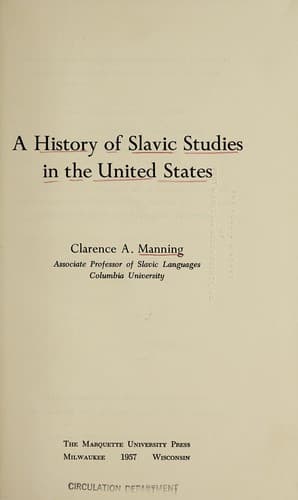
A history of Slavic studies in the United StatesManning, Clarence Augustus
History
A history of Slavic studies in the United States
Manning, Clarence Augustus
Slavic philology -- Study and teaching; Slavs -- History -- Study and teaching
The value of this system was early recognized by the Slavic leaders. At
first the societies were small and purely local but in time the
individual groups tended to unite into central organizations which
acquired larger and larger capital resources. These societies, whether
directly connected with churches or not, gradually came to form a
distinctive feature of Slavic-American life. Today there is no Slavic
group which does not have one or more such organization of national
significance. Among the leaders are the Czechoslovak National Alliance,
the Polish National Alliance, the Ukrainian National Association, the
Serb National Federation, the Polish Roman Catholic Union, the Ukrainian
Workingmen’s Association, the Ukrainian Providence Association, the
Croatian National Alliance. They possess large reserve funds and are
leaders in financial, social, political and cultural work.
Furthermore, as we shall see, it is out of these large, freely
organized, fraternal organizations, with or without church support, that
certain forms of Slavic scholarship have developed in the United States.
This was inconsiderable in the beginning but it has grown and improved
steadily and is destined to play a very important role in the future,
especially in the case of those countries from which there has been an
extensive immigration.
Russian immigration has followed a quite different course. During the
nineteenth century, the Russian Empire tried to channel all movement
from home areas to Siberia instead of across the ocean. For this
purpose, the government appropriated large sums of money and furnished
transportation first from the Black Sea ports to the Pacific coast and
then later along the Trans-Siberian railroad. As a result, prior to
1908, almost the entire Russian immigration into the United States was
from the non-Russian areas in the northwest. This includes the Finns,
the Lithuanians, the Poles and the Jews who began to leave Russia in
large numbers in the nineties because of the anti-Semitic outbreaks.
Public-domain text, read in full here on John Shaqi.
Reviews
Reviews
No reviews yet
Be the first to share your thoughts on this work.
Join the Discussion
Join the discussion
Sign in to leave a comment or review.
Sign InorCreate an account