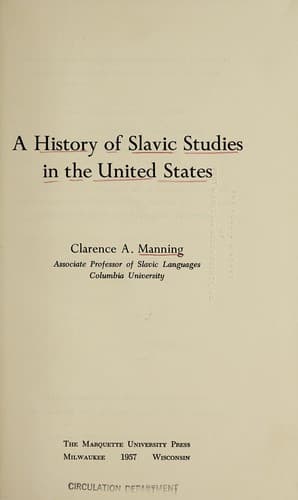
A history of Slavic studies in the United StatesManning, Clarence Augustus
History
A history of Slavic studies in the United States
Manning, Clarence Augustus
Slavic philology -- Study and teaching; Slavs -- History -- Study and teaching
The actual Russian population of Russian Alaska had been small. But,
during the second half of the nineteenth century, after its sale, a
number of Russians drifted across the Pacific Ocean to San Francisco.
The seat of the Archbishopric of the Aleutian Islands and North America
was moved from Sitka to San Francisco. In 1900, there were enough
Russians on the Atlantic coast to warrant Tikhon, later Patriarch of
Moscow, moving his episcopal seat to New York.[16] This was done not
only to serve the needs of the Russian Orthodox population but to enable
him to exert an influence on the Greeks and other Orthodox who had
emigrated to the east coast. About 1905, the difficulties between the
Roman Catholic hierarchy and the Catholics of the Eastern Rite made
opportune a Russian attempt to bring the Eastern Rite adherents back to
Orthodoxy. At the outbreak of World War I the bulk of the Russian
Orthodox Church in America consisted of converts from Galicia and the
Carpathians. There also had been Russian immigration after the
revolutionary disturbances of 1905, but in 1904 the actual Russian
immigration in America was small, far less in numbers than any other
Slavic group except the Bulgarians.
By 1914, the Slavic communities in the United States especially the
Czechs, the Slovaks and the Poles, were already well organized. These,
with their national committees, played a considerable role in securing
the independence of their homeland. They supported directly and through
their American non-Slavic friends the work of Thomas G. Masaryk and
Ignace Paderewski. Similarly, Professor Michael I. Pupin stood out as
the leader of the Serbs and indeed of all the Yugoslavs. The Ukrainians
were less fortunate, for at the moment they had no leader well known to
the American public and they encountered the opposition of both Russian
and Polish groups, whose nations had dominated Ukraine for centuries.
After World War I, the interrupted stream of immigration again broke
through and during the early years it assumed even larger proportions
than it had previously. In addition, many White Russians who had fled
from the Bolsheviks came to the United States.
The cultural level of the Slavic communities rose rapidly, assisted by
better educational opportunities for them both at home and in the
immigration. A large number of highly educated Russians had come over
and the opening of Washington legations for Poland, Czechoslovakia and
Yugoslavia gave the immigrants pride in their own origin and intensified
their contact with cultural work being done in their liberated
homelands. The same effect was achieved by the Ukrainian diplomatic
mission to Washington under Dr. Bachinsky and later Dr. Luke Myshuha,
although unfortunately this did not receive final recognition by the
United States.
Public-domain text, read in full here on John Shaqi.
Reviews
Reviews
No reviews yet
Be the first to share your thoughts on this work.
Join the Discussion
Join the discussion
Sign in to leave a comment or review.
Sign InorCreate an account