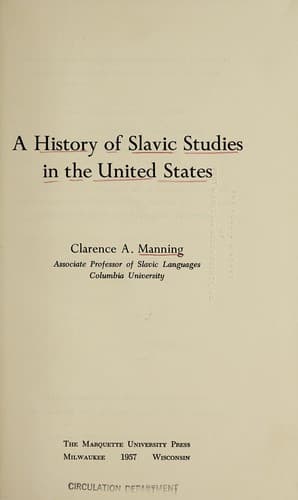
A history of Slavic studies in the United StatesManning, Clarence Augustus
History
A history of Slavic studies in the United States
Manning, Clarence Augustus
Slavic philology -- Study and teaching; Slavs -- History -- Study and teaching
The first translator of Russian poetry in the Anglo-Saxon world was, in
all probability, William David Lewis.[18] His career is typical of this
period. Lewis was born in 1792 in Christiana, New Castle County,
Delaware. He received some education in Clarmont Seminary and Lower
Dublin Academy and was then apprenticed to a merchant. However, his
brother, John D. Lewis, who was established in St. Petersburg as a
merchant asked his younger brother to join him in 1813. This was during
the War of 1812 and the young man, in order to get to Europe, secured a
post as private secretary to the peace commissioners. He sailed for
Europe in 1814. Leaving his post at Gothenburg, he went on to St.
Petersburg where he spent most of his time until 1824.
Lewis had excellent connections in St. Petersburg. He met and became
friendly with Count Nesselrode, with the Cossack leader, Platov, and
also with Nikita Ivanovich Grech, the editor of the _Syn Otechestva_. He
also seems to have met the elderly dean of Russian poetry, Gavriil
Romanovich Derzhavin. It was perhaps under the influence of Derzhavin
and Grech that he began to translate Russian poetry. On January 31,
1821, apparently while on a visit home, he published in the _National
Gazette and Literary Register_ of Philadelphia a poem, _Stanzas_, by
Yuri Aleksandrovich Neledinsky-Meletsky.
Lewis was becoming especially interested in the pre-Pushkin period of
Russian poetry. However, in 1849 he also published in Philadelphia,
where he made his home, a volume of translations entitled the
_Bakchesarian Fountain and Other Poems_, a name taken from one of
Pushkin’s early poems. Grech saw to it that Lewis’ book was
appropriately reviewed and praised in the conservative Russian literary
journals. However, Lewis was not primarily a man of letters and his
contribution ends here. Even before he left St. Petersburg he had
embarked upon a series of disputes with some of the American diplomatic
representatives in the Russian capital and the next decades he spent as
a successful business man and politician. For a time, 1849 to 1853, he
was Collector of Customs in Philadelphia. He died in 1881. Lewis was
slightly ahead of the work of Sir John Bowring who published in 1821–23,
two volumes of _Specimens of the Russian Poets_. He followed these later
with translations from Polish and Serb poetry, inspired by interest in
the Serb folksongs. The translations were widely read in the United
States.
Public-domain text, read in full here on John Shaqi.
Reviews
Reviews
No reviews yet
Be the first to share your thoughts on this work.
Join the Discussion
Join the discussion
Sign in to leave a comment or review.
Sign InorCreate an account