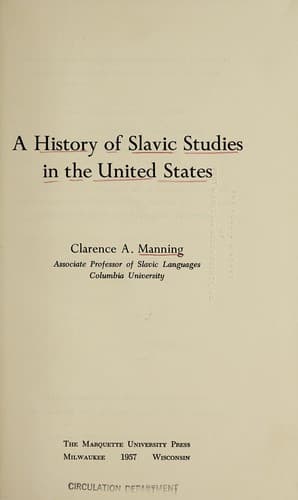
A history of Slavic studies in the United StatesManning, Clarence Augustus
History
A history of Slavic studies in the United States
Manning, Clarence Augustus
Slavic philology -- Study and teaching; Slavs -- History -- Study and teaching
Another of Coolidge’s students was Robert J. Kerner (1887–1956), born in
Chicago. Kerner took his A.B. at the University of Chicago and then
after study in Europe received his Ph.D. from Harvard in 1913. He was at
first connected with the University of Missouri, but in 1928 went to the
University of California at Berkeley, where he spent the rest of his
life. He was made Sather Professor of European History in 1941. When he
retired, in 1954, he was also Director of the Slavic Institute of the
University of California. Professor Kerner, who was of Czech origin, did
most of his work in Czech history, especially the period following the
Battle of the White Mountain. In 1932, he published _Bohemia in the
Eighteenth Century: a Study in Political, Social and Economic History,
with Special Reference to the Reign of Leopold II (1790–1792)_. He
published other works on the Western Slavs and the Balkans. He was
recognized by the scientific societies of both Czechoslovakia and
Romania before World War II and was decorated Commander of the White
Lion of Czechoslovakia, and Officer of the Crown of Romania. Belgium
also honored him for his work at the Peace Conference of 1919 as well as
for later services.
Another pupil of Professor Coolidge, Robert Howard Lord (1885–1954) took
his degree in Harvard in 1910 and remained there on the faculty. In
1915, he published _The Second Division of Poland_. During and shortly
after World War I he was very active in Polish studies and served on the
House Commission of Scholars to prepare materials for the Peace
Conference in 1919. However, he suddenly gave up this field of
scholarship, resigned his post, completely withdrew from previous
scholarly contacts and began to study for the Roman Catholic priesthood.
Perhaps the most important of all of the Harvard students of this period
was George Rapall Noyes (1873–1952). A native of Massachusetts, he
studied with Professor Wiener. From 1898 to 1900, he held a Harvard
University Fellowship for study at St. Petersburg. Upon his return, he
spent a year as Assistant Professor of English at the University of
Wisconsin and then went to the University of California as Assistant
Professor of English and Russian. In the first year of his work at
California he had only five students in Russian and one in Czech, but as
the numbers grew he gradually dropped his work in English and by World
War I he was able to devote himself entirely to Slavic studies.
Public-domain text, read in full here on John Shaqi.
Reviews
Reviews
No reviews yet
Be the first to share your thoughts on this work.
Join the Discussion
Join the discussion
Sign in to leave a comment or review.
Sign InorCreate an account