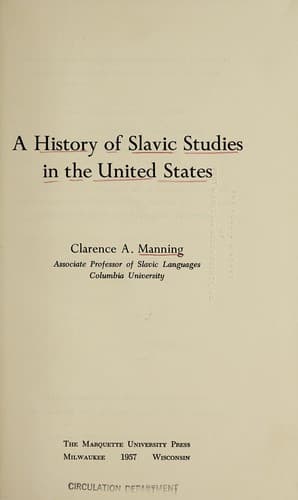
A history of Slavic studies in the United StatesManning, Clarence Augustus
History
A history of Slavic studies in the United States
Manning, Clarence Augustus
Slavic philology -- Study and teaching; Slavs -- History -- Study and teaching
He was an earnest and sincere student, mild but demanding, especially of
himself. He carefully laid out his projected work for years in advance
and maintained a rigid schedule. Any pressure of university duties or
unforeseen calls upon his time he met by including in his work schedule
all those periods which he had left himself for vacations. When he died
in 1952, he was the last of the old generation. He left a gap in Slavic
scholarship that has not yet been filled.
The interest in Russian on the Pacific coast was reflected not only in
the appointment of Golder to Stanford’s history department. In 1918,
Henry Lanz was appointed Professor of Russian Literature and Philosophy
there. Lanz had been born in Moscow in 1886. He was not a very prolific
writer but one of his works on rhythm of language received a prize from
Sweden. Just before the outbreak of World War II, he made another trip
to Europe and stayed for some time in one of the monasteries on Mount
Athos. He died in 1945.
Another outstanding figure of the period was Samuel N. Harper
(1882–1943) of the University of Chicago. Harper was the son of the
first president of the University of Chicago. He studied in the _Ecole
des Langues Orientales_ in Paris and was closely associated with the
group of English Slavists who, under the leadership of Sir Bernard
Pares, K.B.E., gathered at the University of Liverpool and after the war
formed the School of Slavonic Studies at the University of London.
Harper was in Russia with Pares during the Revolution of 1905 and was
very friendly with such liberal Russian leaders as Paul Milyukov. In
1906 he published an English translation of Boyer and Speranski’s
Russian Reader and in 1908 a volume on the _New Electoral Law for the
Duma_. Through his connections at the university and Charles R. Crane,
both Milyukov and Maxim Kovalevsky were brought to Chicago for lectures.
Harper was a constant adviser to the United States government on Russian
affairs. He was convinced that the Russian people, if they had the
power, would definitely accept the Anglo-Saxon theories of democracy, a
position which he maintained in his dealing with the Russian emigres
after the Revolution. He was solidly anti-Bolshevik but in the thirties
he accepted an invitation to visit Moscow, about the same time as Pares
did.
Harper had a wide knowledge of Russian history, and when he was not
traveling, lectured in Chicago and conducted courses in Russian. Yet he
did not build a department of Russian and, despite the large Slavic
population of the city, showed little interest in introducing other
Slavic languages or cultures.
Public-domain text, read in full here on John Shaqi.
Reviews
Reviews
No reviews yet
Be the first to share your thoughts on this work.
Join the Discussion
Join the discussion
Sign in to leave a comment or review.
Sign InorCreate an account