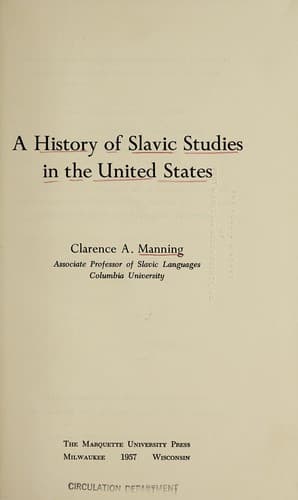
A history of Slavic studies in the United StatesManning, Clarence Augustus
History
A history of Slavic studies in the United States
Manning, Clarence Augustus
Slavic philology -- Study and teaching; Slavs -- History -- Study and teaching
Yet Slavic and East European studies are not in the same position as
they were in past decades in Germany, France and the British Isles.
There, they were definitely intellectual disciplines which might find
practical use in certain governmental and educational posts but which
were of interest only to a small number of specialists. In those
countries there were learned professors of Slavic. This is especially
true of Germany and France where relatively large groups of outstanding
Slavs, chiefly of the educated, professional and political classes, were
able to influence higher level thought in those countries. Few ordinary
Slavs appeared in either country. Those who did were mostly migratory
workers who did not take root in their new environment, and exercised
little influence.
That is not true in the United States. There were before World War I a
small number of outstanding representatives of the Slavic nations, free
or not. But the United States was also brought face to face with the
immigration of millions of Slavic workmen and peasants. These brought
little material or consciously intellectual baggage to the country but
took root here and, under the leadership which they developed in the
United States, have played a steadily increasing role in American life.
They and their descendants of the second and third generations are not a
negligible force. Their children and grandchildren may have lost a
certain facility in the use of their mother tongues but they have
retained qualities, knowledge and traditions which are vital to the
United States today and which cannot fail to have a far-reaching effect
upon the entire world in the future.
We cannot then speak of Slavic studies merely in the narrow sense of the
word. We must take into account these other factors which are rapidly
becoming tangible elements in all of American life. In this sense we
must consider Slavic and East European studies to include those means
other than political propaganda which have led to the present American
knowledge of the Slavic world, a knowledge with some striking insights
and some equally amazing gaps.
The present survey is an attempt to handle all aspects of the growing
awareness of the Slavs by the American people and the American
educational system. Yet we can hardly do this without a brief survey of
the way in which the Slavs appeared on the American scene and the
methods by which they have come to assume their present position. The
complete history of this has never been written though we do have a fair
outline of the various stages of the movement.
CHAPTER 1
THE SLAVS IN AMERICA
Public-domain text, read in full here on John Shaqi.
Reviews
Reviews
No reviews yet
Be the first to share your thoughts on this work.
Join the Discussion
Join the discussion
Sign in to leave a comment or review.
Sign InorCreate an account