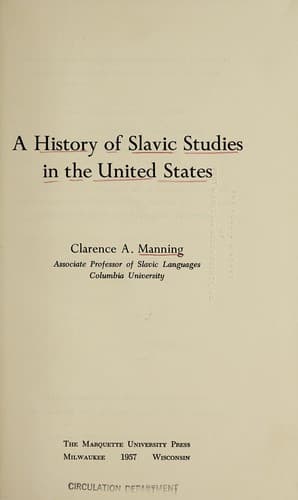
A history of Slavic studies in the United States — John Shaqi
A history of Slavic studies in the United StatesManning, Clarence Augustus
History
A history of Slavic studies in the United States
Manning, Clarence Augustus
Slavic philology -- Study and teaching; Slavs -- History -- Study and teaching
We have no records of the arrival in what is now the United States of
the first Slavic nationals. We don’t know from where they came or where
they settled. But it seems certain that at an early date Slavs appeared
in all of the various streams of colonization though primarily as
individuals. We must remember that it was not until the nineteenth
century that the world became seriously interested in the nationality
and language of a person. The medieval period had thought only in terms
of allegiance to a given monarch or to some supernational state which
embraced persons of many tongues and origins, united in a common
loyalty.
This held true for the first two centuries of American settlement and we
always have to take it into account. It may be well to glance briefly,
then, at the political situation in the Slavic lands, from the discovery
of America through the next century.
Christopher Columbus discovered the New World less than a half century
after the fall of Constantinople to the Turks and the liberation of
Moscow from the Tatar yoke. Europe was filled then as now with homeless
people, the Christians of the Byzantine Empire and of the Balkan
Christian states, preferring the hardships of a wandering life to
existence under the Mohammedan Turks. The armed forces of all countries
were filled with adventurers who had been driven from their homes and
were glad to fight as mercenaries.
For example, there were Greek soldiers in the armies of Francisco de
Pizarro in his conquest of Peru in 1532. Later these same men took sides
with Diego de Almagro in his revolt against Pizarro and made for him the
first cannon cast in the New World.[1] This intermixture of
nationalities continued throughout the era of the discovery and the
ensuing decades. This was the height of the Spanish power and it was
under the flag of Spain that men of all nationalities, especially from
the Mediterranean area, went to serve.
At this time, the most powerful Slavic state was the Polish Republic,
the _Rzeczpospolita Polska_. Yet this was far more than ethnographic
Poland. It took in almost all Ukrainian and Byelorussian lands as well
as ethnographic Lithuania and Latvia and a considerable part of eastern
Germany. It maintained the closest connections with the Danubian
principalities and even Hungary. Thus, a person known as a Pole could
very easily have been one of several Slavic and even non-Slavic
nationalities.
The Czechs formed the nucleus of the Kingdom of Bohemia, itself a
subsidiary of the Hapsburg domains, the Holy Roman Empire (which, to use
the words of Voltaire, was already ceasing to be either Holy, Roman or
an Empire). The Slovaks and the Carpathian Ukrainians were under the
Crown of St. Stephen of Hungary as were the Croats, while the Slovenes
were more particularly connected with Austria. Yet again, the lands of
the Crown of St. Stephen were also part of the Empire.
Public-domain text, read in full here on John Shaqi.
Reviews
Reviews
No reviews yet
Be the first to share your thoughts on this work.
Join the Discussion
Join the discussion
Sign in to leave a comment or review.
Sign InorCreate an account