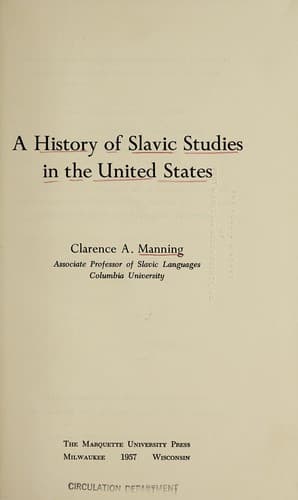
A history of Slavic studies in the United StatesManning, Clarence Augustus
History
A history of Slavic studies in the United States
Manning, Clarence Augustus
Slavic philology -- Study and teaching; Slavs -- History -- Study and teaching
In this crisis, and in the hope that the Russian Revolution would
promote democratic contacts and trade with the United States, some of
these former German professors announced courses in Russian. There was
often something humorous and grotesque about this, for there were few if
any textbooks and the professors themselves had little knowledge of the
language. The situation in some cases was scandalous. There is little
reason to do more than mention the existence of this situation. Even
well-known scholars lent themselves to it, only to report a few years
later that there was no call for Russian. As a result, the sudden flurry
of Russian courses was without result and in the years after the War,
they were more or less quietly abandoned. It accentuated the common
notion that Russian could not be learned, an idea energetically fostered
for various reasons. No one took the trouble to realize that the
necessary preliminaries, such as the publication of grammars, were yet
to be done. There were no books available, save a few published in
England, and no real teachers, save some chance immigrants who owed
their opportunities more to good fortune than to ability or training.
Yet the war period did serve to strengthen those departments which had
been previously established. It brought a few new individuals into the
picture and above all it aroused a sense of need that was slowly to be
satisfied.
CHAPTER 5
SLAVIC EFFORTS BEFORE WORLD WAR I
In the preceding chapters, dealing with the gradual development of an
intellectual interest in Slavic questions, we have largely ignored the
activity of Slavic groups in the United States. This was deliberate, for
the early stages of Slavic study were almost completely apart from the
work of the Slavs themselves and involved only those persons who had
come to the United States and achieved prominence or success outside of
their own communities and background.
These early Slavic efforts could make little imprint upon the American
public, for the first steps were taken under most adverse conditions.
The Slavic masses were composed for the most part of the underprivileged
groups who had come to America in the hope of working for a few years
and then returning. Later they became American citizens, but until 1914
a surprising percentage of the Slavs had not taken out citizenship
papers.
For their self-protection and mutual advantage these masses had formed
their own churches and fraternal organizations. There were in the
nineteenth century many difficulties to be encountered by each and the
communities lived apart with relatively little social or political
contact with the rest of the population.
Public-domain text, read in full here on John Shaqi.
Reviews
Reviews
No reviews yet
Be the first to share your thoughts on this work.
Join the Discussion
Join the discussion
Sign in to leave a comment or review.
Sign InorCreate an account