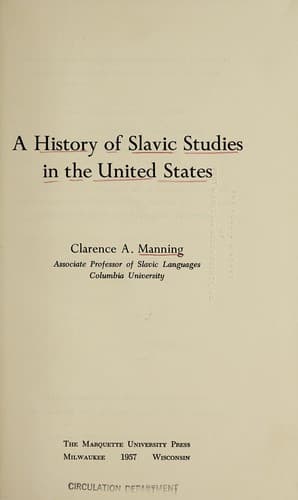
A history of Slavic studies in the United States — John Shaqi
A history of Slavic studies in the United StatesManning, Clarence Augustus
History
A history of Slavic studies in the United States
Manning, Clarence Augustus
Slavic philology -- Study and teaching; Slavs -- History -- Study and teaching
At about the same time, Czech was included in the University of Iowa
where Miss Anna Heyberger conducted the work. Still later she changed to
Coe College at Cedar Rapids where she became Professor of French and
took a doctorate, with a dissertation on the Czech educator Jan Amos
Comenius, at the University of Paris. Alois Barta was then giving
instructions at Dubuque College and Seminary. For a while before World
War I, B. Prokosch gave courses in Czech at the University of Wisconsin
and Leon Zelenka Lerando at Ohio State University but more lasting
results were obtained by Mr. Charles Knizek at the University of Texas,
where Czech has continued almost without a break since its
introduction.[34] At this time, still other developments, largely
connected with the various churches, were ensuing. For example, Reverend
Andrew Slabey was appointed to the International Baptist Seminary in
Montclair, New Jersey, an institution greatly concerned with training
clergymen for missionary work among various non-English groups and
extensively staffed for such foreign languages as Slovak, Ukrainian and
Hungarian. On the other hand, the Russian Orthodox Archbishop of the
Aleutian Islands and North America established a small Russian seminary
at Minneapolis, Minnesota. This was later moved to Tenafly, New Jersey,
and its head was Reverend Leonid Turkevich, the present Archbishop
Leonty of the Russian Orthodox Church in North America.
We could extend this list even further, but the institutions at this
period cared for little more than the giving of elementary instruction
in a Slavic language, usually either Czech or Polish. The period
witnessed the publication of a considerable number of elementary
grammars, dictionaries and readers. Many of these were not of high
quality but they did reflect the growing maturity of the various Slavic
communities and their efforts to secure the introduction of their
languages into the curricula of American institutions. Furthermore, at
this period, it was rare that any person in one of these smaller state
institutions could secure a post exclusively in Slavic studies. The best
and most scholarly were compelled to carry almost a full load in some
other subject. But the mere fact that this was possible accents the
increasing number of young Slavs who were securing college and
university educations. The situation was still not healthy but at the
beginning of World War I it was by no means as hopeless as it had seemed
earlier.
CHAPTER 6
FROM 1914 TO 1939
As we have seen, Slavic studies were in their infancy when World War I
broke out. The American reaction to the War was, as we might have
expected, a plain paradox.
Public-domain text, read in full here on John Shaqi.
Reviews
Reviews
No reviews yet
Be the first to share your thoughts on this work.
Join the Discussion
Join the discussion
Sign in to leave a comment or review.
Sign InorCreate an account