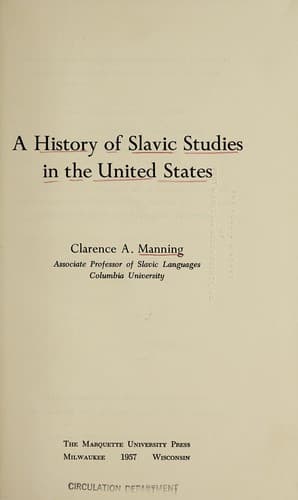
A history of Slavic studies in the United StatesManning, Clarence Augustus
History
A history of Slavic studies in the United States
Manning, Clarence Augustus
Slavic philology -- Study and teaching; Slavs -- History -- Study and teaching
During World War I, the outburst against the use of German spread in
Nebraska to all foreign languages. The courses in the university were
dropped and the department was abolished, while Professor Hrbkova moved
to New York and became the manager of the Czechoslovak Section of the
Foreign Language Information Service, ancestor of the Common Council for
American Unity. The outburst was even worse against Czech courses in the
lower schools and in 1919 the so-called Siman Bill provided that “no
person, individually or as a teacher, shall, in any private,
denominational, parochial or public school, teach any subject to any
person in any language other than the English language.” This was made
more stringent in 1921 but in 1923, the measures were declared
unconstitutional by the United States Supreme Court.
In the meantime, the break in the university courses was less prolonged.
In 1919–20, during the meeting of the State Constitutional Convention,
two members of Czech origin raised the question of a renewal of the
courses. After negotiations, the teaching of Czech was renewed in the
autumn of 1920 under Professor Orin Stepanek. Stepanek, a native of
Nebraska, received his A.B. from the University of Nebraska in 1913 and
an A.M. from Harvard in 1914. After service in the U.S. Marine Corps he
returned to Harvard and then went to serve under General Snejdarek on
the Magyar frontier. After this, he returned to Nebraska and there
became Assistant Professor of English. While there, he was also giving
courses in Czech and Russian under the auspices of the Department of
Modern Language and, later, of Romance Languages.
We have stressed the history of the establishment of Slavic work at the
University of Nebraska because the Czechs were sufficiently numerous and
influential to be able to reach the university authorities and the state
legislature. More than that, they were persistent and finally succeeded
in securing recognition. Yet in its way, the same type of politics, in
addition to formal applications, was going on with various degrees of
success in many different places.
Public-domain text, read in full here on John Shaqi.
Reviews
Reviews
No reviews yet
Be the first to share your thoughts on this work.
Join the Discussion
Join the discussion
Sign in to leave a comment or review.
Sign InorCreate an account