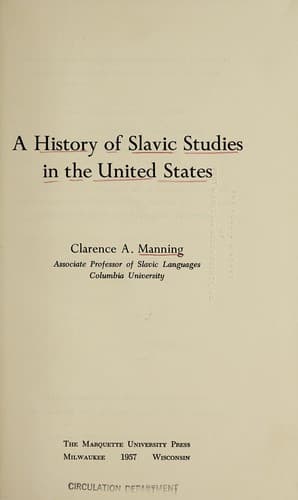
A history of Slavic studies in the United StatesManning, Clarence Augustus
History
A history of Slavic studies in the United States
Manning, Clarence Augustus
Slavic philology -- Study and teaching; Slavs -- History -- Study and teaching
The evacuation of all Russian territory, and such a settlement of
all questions affecting Russia as will secure the best and freest
cooperation of the other nations of the world in obtaining for her
an unhampered and unembarrassed opportunity for the independent
determination of her own political development and national policy,
and assure her of a sincere welcome into the society of free nations
under institutions of her own choosing and more than a welcome,
assistance of every kind that she may need and may herself desire.
On the other hand the non-Russian peoples of the old empire paid no
attention to these remarks by President Wilson. They saw rather the
general principles enunciated in the Fifth Point, “A free, open-minded
and absolutely impartial adjustment of all colonial claims based upon a
strict observance of the principle that in determining all such
questions of sovereignty the interests of the populations concerned must
have equal weight with the equitable claims of the Government whose
title is to be determined.” In fact he went further and on July 4, 1918
he declared in the “Four Ends” speech: “The settlement of every
question, whether of territory or sovereignty, of economic arrangement,
or of political relationship, upon the basis of the free acceptance of
that settlement by the people immediately concerned, and not upon the
basis of the material interest or advantage of any other nation or
people which may desire a different settlement for the sake of its
exterior influence or mastery.”
Thus the doctrine of self-determination definitely pronounced by
President Wilson was carried still further by the people of the old
Russian empire than he had himself intended. He only provided for
independence for Finland, Poland and Armenia, three peoples who had won
the special sympathy of the American people. In the case of all others,
he was prepared to rest upon his Sixth Point and neglect careful and
accurate study of the conditions prevailing in Eastern Europe.
If space permitted, we could trace this idea in the American attitude to
the Peace of Brest Litovsk, the actions of the American Expeditionary
Forces in Archangel and Vladivostok, the attitude toward the Russian
White armies, the refusal to grant an Eastern border to Poland under the
Treaties of Versailles and Saint Germain, the refusal to recognize the
cession of Bessarabia by Russia to Romania and many other questions. It
insured high favor from those entirely removed from Austria-Hungary and
Germany and relative disfavor from all peoples trying to separate
themselves from Russia.
Public-domain text, read in full here on John Shaqi.
Reviews
Reviews
No reviews yet
Be the first to share your thoughts on this work.
Join the Discussion
Join the discussion
Sign in to leave a comment or review.
Sign InorCreate an account