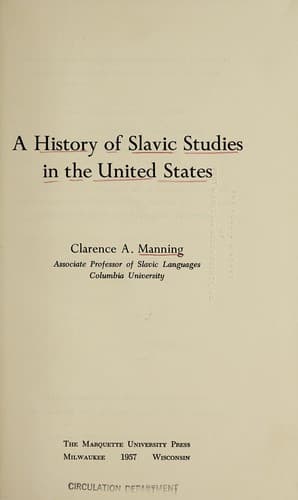
A history of Slavic studies in the United StatesManning, Clarence Augustus
History
A history of Slavic studies in the United States
Manning, Clarence Augustus
Slavic philology -- Study and teaching; Slavs -- History -- Study and teaching
In addition to these institutions, the displaced persons opened many
more elementary schools on all educational levels to train their fellow
countrymen whose education had been interrupted by the War and the
limitations imposed on general education, both by the Soviets and the
Nazis.
By a series of fortunate coincidences, the majority of the
administration of the old Shevchenko Scientific Society in Lviv, and a
large part of its membership were saved in the DP camps. There, this
society, which had been suppressed by the Soviets in 1939 after their
occupation of Lviv, was again revived under the same officers in Munich.
The center was later moved to Sarcelles near Paris. Many of its members
have come to the United States, and while the headquarters are still in
Sarcelles, American and Canadian branches have been established in New
York and Toronto and are working actively, publishing the results of
their studies in both Ukrainian and English.
At about the same time, other Ukrainians in the camps, perhaps more
often from eastern Ukraine, formed the Ukrainian Free Academy of
Sciences. Its members have also come, in numbers, to America and are
functioning in New York and Winnipeg. They publish the quarterly
_Annals_ in English, greatly aided by the East European Fund set up by
the Ford Foundation.
These two groups, which parallel the Polish Institute of Arts and
Sciences in America, have counterparts in the Francis Skorina Society
(Kryvian), and the White Ruthenian Institute of Arts and Sciences in the
U.S., the Croatian Academy of Liberal Arts and Sciences, and the Serb
National University in Chicago. The Masaryk Institute, formed by a group
of Americans and Czechs before the Nazi occupation of Czechoslovakia, is
in a sense similar but it has also the features of the Kosciuszko
Foundation. It is too early to know what position these societies will
take in Slavic programs of the future, but their outstanding individuals
are securing recognition in American colleges and universities. Whether
they will ultimately form a branch of this general educational field or
whether they will develop into more highly specialized groups drawing
upon interested Americans of non-Slavic origin, cannot now be answered
with certainty. Some of them are undoubtedly ephemeral but some have had
a long cultural tradition and can be expected, in their new environment,
to exercise an influence out of proportion to their numbers.
Public-domain text, read in full here on John Shaqi.
Reviews
Reviews
No reviews yet
Be the first to share your thoughts on this work.
Elsewhere in the archive
Join the Discussion
Join the discussion
Sign in to leave a comment or review.
Sign InorCreate an account