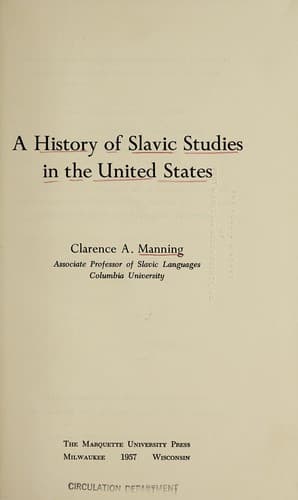
A history of Slavic studies in the United StatesManning, Clarence Augustus
History
A history of Slavic studies in the United States
Manning, Clarence Augustus
Slavic philology -- Study and teaching; Slavs -- History -- Study and teaching
The same division can be seen in the distribution of aid, in the early
years, of the work of the East European Fund, Inc., which was created by
the Ford Foundation and has done much valuable work. In its later years
it has given more money to aid in the preparation and publication of
works by Ukrainian, Byelorussian and other scholars and is publishing a
series of Ukrainian texts, either original works or books suppressed by
the Soviet government. But all of these publishing activities fall far
short of the work of the Chekhov Publishing House which has issued over
100 Russian books and received for this, grants (up to 1954) totaling
$1,238,000. However, on the average, as shown by the Fund’s report for
1954, the grants to the several Ukrainian and Byelorussian
(Whiteruthenian) scholarly and relief institutions have never been more
than a third, at most, of that contributed for similar Russian purposes,
in spite of its stated position of refraining from “favoring or
supporting any single Russian political grouping.” The report shows how
the Fund has tended however to see more value in the Russian projects
than in the Ukrainian and Byelorussian (Whiteruthenian).[44]
Gradual changes of attitude can also be noted in the American-supported
publications of the Institute for the Study of the USSR in Munich, which
is intended as a means for assistance to refugee scholars from the USSR,
and in the various American radio and other organizations intended to
aid in the fight against Communism, such as the American Committee for
Liberation from Bolshevism. It is to be noted also in the policy of
George Kennan, formerly of the State Department and now connected with
the Institute for Advanced Study in Princeton, New Jersey, who is
considered an outstanding American authority on the USSR. His entire
policy of “containment” has long been based on the same idea of Russian
unity as expressed by his uncle, George Kennan (See Chapter III).
To supplement these and similar tendencies in the study of the satellite
states menaced by Communism, there has been established in New York
another series of organizations to secure American help, to furnish
scholarly opportunities for displaced scholars from the countries
liberated after World War I and to assist in training new students. This
is the Mid-European Studies Center. Its counterparts in Europe are Radio
Free Europe and in the university field in the United States, the
Mid-European Studies Program at Columbia University. This is more or
less on the pattern of the Russian Institute and it is but one example
of the efforts that are being made to develop interest in the culture of
the satellite states, which, save for the efforts of their compatriots
in the United States, have been largely neglected.
Public-domain text, read in full here on John Shaqi.
Reviews
Reviews
No reviews yet
Be the first to share your thoughts on this work.
Elsewhere in the archive
Join the Discussion
Join the discussion
Sign in to leave a comment or review.
Sign InorCreate an account