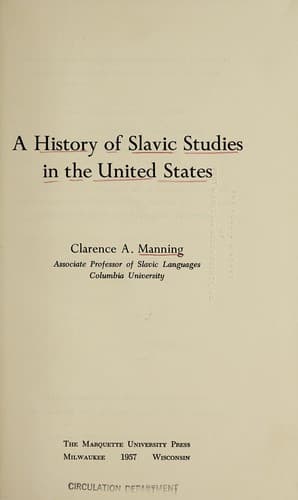
A history of Slavic studies in the United StatesManning, Clarence Augustus
History
A history of Slavic studies in the United States
Manning, Clarence Augustus
Slavic philology -- Study and teaching; Slavs -- History -- Study and teaching
A point often raised regarding studies in this area is the limitation
placed upon them by the American distrust of Communism which has
expressed itself in many Congressional investigations as well as the
public and private attempts to root out from the various important
fields open or secret Communists or fellow-travellers. This point is
raised by Professor James F. Clarke of the University of Indiana:[45]
In more recent times a similar blind emotional reaction to Communism
as well as partisan evaluations of the Soviet Union have constituted
a threat to the free and rational expansion of East European
studies. Today, college students, teachers, and administrators
interested in the area dominated by Communism, while they may not
yield to anti-Communist hysterics, must at the same time heed its
potential effect on parents, taxpayers, legislators, trustees and
employers.
It is the opinion of the present writer that such arguments serve merely
to cover the failure of the scholars to interpret the complications of
the Soviet mode of thought to an American audience. The Aesopian
language in which so much of the current Communist propaganda is
couched, both for home and foreign consumption, and the belief that
truth is what is best at the moment for the Communist Party, have laid a
responsibility upon students of Eastern Europe, a burden not borne by
the more established subjects where the sources are less subject to
deliberate falsification. In addition to this, certain men who followed,
during World War II, the tendency to gloss over the cruelties of the
Soviet Union on behalf of mutual understanding and a misinterpreted
liberalism now find it difficult to disavow some of their most
tendentious writings. This by no means implies that they are either
Communists or fellow-travellers but they deliberately closed their eyes
to unpleasant situations, and now shrink from admitting the full truth.
As we have noted above, few, if any, of the outstanding scholars of
Slavic have accepted Communist ideas. The burden of Communist
infiltration in the past, and in the present, has been in departments
and subjects that might be considered most immune to them, especially
some of the natural sciences which have only recently become subjects
for international intrigue and spying. For this reason, the fears of
being labeled a Communist are far less vital than the pressure that has
been exerted at many different periods to present Communism as a liberal
doctrine that is in harmony with American ideals. It is this misplaced
liberalism that has been responsible for what the author of the article
quoted calls “anti-Communist hysterics.”
Public-domain text, read in full here on John Shaqi.
Reviews
Reviews
No reviews yet
Be the first to share your thoughts on this work.
Elsewhere in the archive
Join the Discussion
Join the discussion
Sign in to leave a comment or review.
Sign InorCreate an account