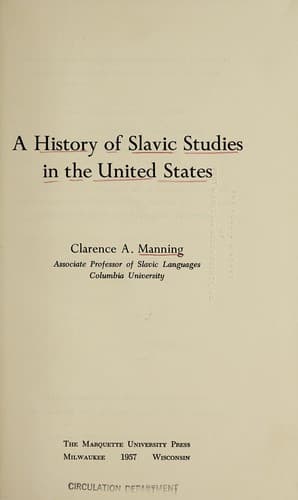
A history of Slavic studies in the United StatesManning, Clarence Augustus
History
A history of Slavic studies in the United States
Manning, Clarence Augustus
Slavic philology -- Study and teaching; Slavs -- History -- Study and teaching
In addition to this, any objective study of the Communist-dominated
world is rendered impossible, if the supplemental goal is to promote
mutual understanding. This of course is an object of study when the
system of two distinct peoples is founded upon the same general
principles, and when words are used on both sides with similar meanings.
In a study of the Communist world, far more can be effected by a
rigorous emphasis on the differences than can be gained by soft-pedaling
and concealing them.
Another important factor that has worked against the increase of
students in the East European field has been the nature of the
opportunities which are offered to students. Immediately after the
liberation of the Slavic countries, after World War I, there seemed to
be a chance that students who acquired some knowledge of Slavic could
put it to use in their ordinary vocations. Those opportunities for
employment abroad that loomed so large in the calculations of students
of Spanish proved to be conspicuously absent in view of Communist
actions.
The spurt that occurred after World War II came to an end when the Iron
Curtain descended over almost the entire Slavic world, at least so far
as the average student was concerned. Men who had received some
instruction while in the Armed Services were able to take advantage of
the GI Bill of Rights and continue their studies. Yet most very soon
found that unless they intended to become real specialists, they would
not have the opportunity to use their knowledge.
The colleges and universities needed more men in view of the widespread
conviction that Russian, especially, was a proper and necessary subject.
Yet the field was relatively limited and did not require many
generations of post-graduate students to adequately staff the
departments. The chief opportunity besides teaching was government
service and this absorbed the greatest number. But, for those who did
not care for government work the range of opportunities soon became
restricted.
Most of these men and women, who are today specializing actively, are
persons who have received fellowships of some kind or value from one or
another of the larger foundations (the Rockefeller, Carnegie Corporation
and the Ford Foundation). As in other branches of scholarship, and even
the sciences, or those humanistic subjects which almost insure teaching
positions, these fellowships and scholarships play a more important part
in the economic life of the graduate student than ever before and any
increase or decrease in them is reflected almost immediately in the
number of students. The result has been a steady but perceptible drop in
graduate students during the past years. This has not been a bad sign in
reality, even though it may superficially seem a lack of interest.
Public-domain text, read in full here on John Shaqi.
Reviews
Reviews
No reviews yet
Be the first to share your thoughts on this work.
Elsewhere in the archive
Join the Discussion
Join the discussion
Sign in to leave a comment or review.
Sign InorCreate an account