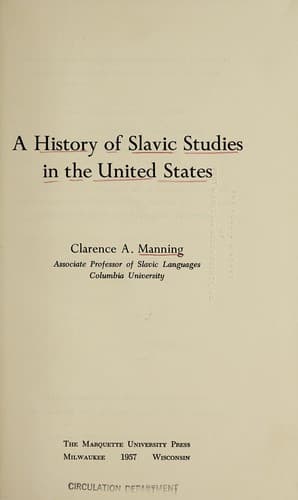
A history of Slavic studies in the United StatesManning, Clarence Augustus
History
A history of Slavic studies in the United States
Manning, Clarence Augustus
Slavic philology -- Study and teaching; Slavs -- History -- Study and teaching
Furthermore, the area also includes the Uralic-Altaic peoples, the
Finns, Estonians, Hungarians, Turks and many less developed peoples.
These can hardly all be treated as offshoots of Slavic. The Uralic
peoples, especially those who are most highly developed, have shared the
influences of the Slavs, and have been closely connected with Western
Europe. The Finns and Estonians have had strong Scandinavian contacts
and the Hungarians have been closely associated with the Empire, the
Poles and the Czechs. The Altaic peoples, largely Mohammedan, have
become an inherent part of Islamic culture and yet, despite their
distinct linguistic and cultural heritage, their fate has been closely
linked with that of the Slavs. In addition, there are the modern Greeks,
direct heirs of the Byzantine tradition with their own sharply defined
culture; the Romanians, who are proud of their Latin traditions; and the
Albanians, who form a distinct Indo-European linguistic group crowded
between the Southern Slavs and the Greeks. Neither can there be excluded
such peoples of the Caucasus as the Georgians, the Armenians and the
Azerbaijanians, nor other Christian and Mohammedan peoples formerly
included in the Russian Empire.
The time is long past when all of these national groups can be studied
only in terms of the Russian and Ottoman Empires. Their history and
their struggles for liberation create many cultural subsections which
cut across linguistic boundaries and, in part, natural geographical
subdivisions. It is difficult to name satisfactorily these cultural
subsections, for they vary in the different periods of history. Yet, the
definition of courses of detailed study or area programs, which have
become so popular at the present time, demands it.
There is another difficulty which arises. The events of World War II and
the creeping Soviet imperialism have succeeded in dominating all of the
states which were established, or attempted after World War I. In the
western extension of the Iron Curtain, only Finland in the north and
Greece and Turkey in the south have succeeded in maintaining a
precarious independence. As a result, all of the programs of instruction
that have been arbitrarily set up exclude these three countries.
Whatever value such a division may have at present, it is certainly no
guide to the past, for at times Finland was under Swedish rule, which
extended south of the Gulf of Finland. Likewise, for centuries Greece,
the Southern Slavs and Romania (then divided between Wallachia, Moldavia
and Transylvania), together with Ukraine, formed another definite
cultural block, which to a large degree shared the same political fate.
Public-domain text, read in full here on John Shaqi.
Reviews
Reviews
No reviews yet
Be the first to share your thoughts on this work.
Elsewhere in the archive
Join the Discussion
Join the discussion
Sign in to leave a comment or review.
Sign InorCreate an account