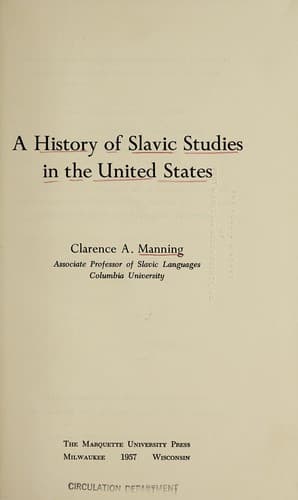
A history of Slavic studies in the United States — John Shaqi
A history of Slavic studies in the United StatesManning, Clarence Augustus
History
A history of Slavic studies in the United States
Manning, Clarence Augustus
Slavic philology -- Study and teaching; Slavs -- History -- Study and teaching
Little is heard of Russians at this period, although American
representatives had appeared in St. Petersburg during the Revolution and
the Tsars, in the early 1800’s, began to send diplomatic representatives
to Washington. Prince Dimitry Golitsyn,[10] a member of a socially
prominent Russian family, was the first Roman Catholic priest to be
fully trained and ordained by Bishop Carroll in the United States. He
continued until the end of his life to be one of the leading Catholic
priests in Pennsylvania, and maintained contact with the Russian
Ministers in Washington. We also know that in 1800, Kutusoff mantles and
bonnets were very popular in New York society.[11]
Until 1848, the Slavs who came to the United States came either as
individual travelers or as individual immigrants, perhaps drawn in the
train of some more prominent compatriot. There are several interesting
accounts of this period, in Polish, such as those by Juljusz Ursin
Niemciewicz who came with Kosciuszko in 1797 and remained in the country
for several years. He visited Boston around 1799 and his diary mentions
a Polish Unitarian library, the _Bibliotheca Fratrum Polonorum_, in
Harvard of which nothing is now known.[12]
The situation was different in the Pacific northwest.[13] The Russians
during the seventeenth and eighteenth centuries reached the Sea of
Okhotsk and Kamchatka in their eastward advance and began to push into
the north Pacific in quest for furs. Late in the century they started to
establish more or less temporary trading posts on the Aleutian Islands.
In 1783, Grigory Shelikov established a more permanent center at Kodiak.
This center of Russian influence was later transferred south to St.
Michael on the site of the present Sitka in 1800. (The ablest Russian
governor, Aleksander Baranov, went further. In 1811 he sent his most
trusted assistant, Ivan Kuskov, to establish a Russian trading post at
Fort Ross, not far from San Francisco). Shelikov had founded the
Russian-American Company to exploit these new lands, and his talented
successor, Nikolay Rezanov, visited the New World in 1805, dreaming of
controlling the entire Pacific coast, including the Spanish settlements
in California with San Francisco as their head. On his return across
Siberia he died at Irkutsk as the result of a fall from his horse and
his dreams largely perished with him, although later the Russians did
try to seize the Hawaiian Islands and make the north Pacific a Russian
lake.
Fortunately for the Americans, the Russian settlements were poorly
supported from St. Petersburg and the intricacies of Russian law left
Baranov and his successor without the necessary supplies and they were
compelled to indulge in illegal trade with the British. Boston merchants
also carried to Kodiak and Sitka the goods which the Russian-American
Company had neglected to send.
Public-domain text, read in full here on John Shaqi.
Reviews
Reviews
No reviews yet
Be the first to share your thoughts on this work.
Join the Discussion
Join the discussion
Sign in to leave a comment or review.
Sign InorCreate an account