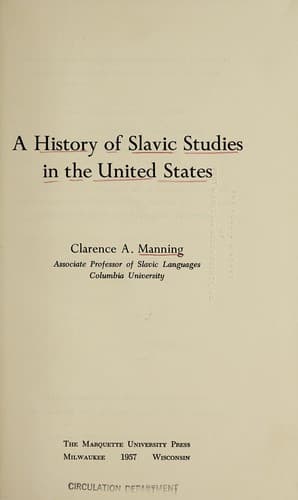
A history of Slavic studies in the United StatesManning, Clarence Augustus
History
A history of Slavic studies in the United States
Manning, Clarence Augustus
Slavic philology -- Study and teaching; Slavs -- History -- Study and teaching
In the eighteenth century there is the same uncertainty. In 1741 a group
of the _Unitas Fratrum_ (the Bohemian Brethren) from Bohemia and
Moravia, were led by Count Zinzendorf to a settlement in Bethlehem,
Pennsylvania. It is at least possible that some of these settlers spoke
Czech as well as German. If they did, it would explain more clearly the
interest in the community that was taken during the American Revolution
by General Kasimierz Pulaski, who seems to have made a point of
attending religious services there whenever he could. The architecture
of the older buildings further suggests Slavic influence.
The American Revolution brought to the New World another group of Slavs,
of whom the best known are the two Polish leaders, Generals Pulaski[7]
and Tadeusz Kosciuszko.[8] Pulaski, already a well-known figure in
Poland, brought with him a number of other East Europeans and Slavs who
formed a considerable portion of the famous Pulaski Legion. We have also
the names of others, such as Count Bienowski and Colonel Michael Kovach,
an Hungarian, a member of the Legion who was killed at Charleston, South
Carolina, in 1779. Most of the Legion’s survivors stayed in the new
country.
Another possible source for inspiring Slavs, and especially Poles, to
come to America was the career of Major General Charles Lee,[9] of the
American Army. He had once been in command of the Cadet School in Warsaw
founded by King Stanislaw Poniatowski. In addition to that, most of the
French troops who served in America had previously been on duty in
western Poland supporting the Saxon claims to the throne and helping the
Poles oppose Russian domination. There is no way of knowing whether or
not this force had received Slavic recruits during its term of duty
there. The services of both Pulaski and Kosciuszko, and the later return
of Kosciuszko to the United States in 1797, built up considerable
interest for Poland in the United States. This continued for nearly a
half century, leading to a fair amount of immigration from the former
Polish state, especially after the Polish Revolt of 1831.
Moreover, American newspapers of the time published long accounts of
events in Europe. Thus, in 1733 John Peter Zenger included in the New
York _Weekly Journal_ an account of the efforts of Stanislaw Leszczynski
to secure the throne of Poland. Numerous similar examples could be
cited. However, no organized interest in Slavic lands and peoples
developed.
Public-domain text, read in full here on John Shaqi.
Reviews
Reviews
No reviews yet
Be the first to share your thoughts on this work.
Join the Discussion
Join the discussion
Sign in to leave a comment or review.
Sign InorCreate an account