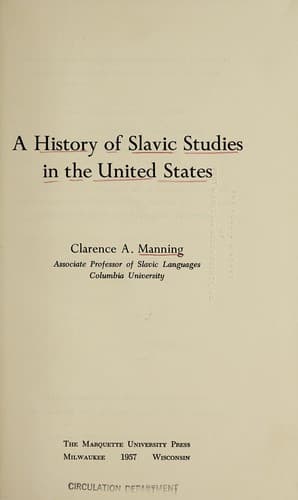
A history of Slavic studies in the United StatesManning, Clarence Augustus
History
A history of Slavic studies in the United States
Manning, Clarence Augustus
Slavic philology -- Study and teaching; Slavs -- History -- Study and teaching
For many years, the nations of the Balkan Peninsula were treated as a
Balkan block and, because of the ways these states secured their
political independence, they shared years of stormy political life. The
term “Balkans” was then, with considerable contempt, applied to Greece,
Bulgaria, Serbia, Montenegro, Albania and Romania. Yet after World War
I, when the Adriatic littoral was added to Serbia and Montenegro to form
Yugoslavia and Romania recovered Transylvania and Bessarabia, the name
came to have little meaning. Now with Turkey playing a positive role,
efforts have been made to use the name Southeastern Europe, but with
little success. “Danubian Europe” is worse, for the Danube crosses both
Austria and Hungary, and avoids Greece and Albania.
At the present time, the term “Eastern Europe” is probably the least
objectionable but it is ridiculous to apply this term to Czechoslovakia
and Hungary which are almost in the heart of Europe. Still, this is the
term, added to Slavic or Slavonic, used as a general title by both the
British _Slavonic and East European Review_ and _The American Slavic and
East European Review_. But the culture area also includes all of the
former Russian possessions in Asia, for the Urals owe their position as
the boundary of Europe more to the fact that they run roughly north and
south at the eastern end of the Caspian Sea, and so are useful to
cartographers, than to any historical importance.
The term “Mid-Europe” has been introduced lately to cover the history of
that strip of countries which won their independence after World War I
and lost it after World War II. It is an attempt to unify the
non-unifiable, except in terms of their present fate, for during much of
the last thousand years the fate of Czechoslovakia, Poland and Hungary
has been intertwined, but Poland has been involved with Lithuania,
Byelorussia (White Ruthenia), and Ukraine, while the main relations of
Latvia and Estonia have been with the Scandinavian and other Baltic
peoples.
For purposes of detailed study then, a division can be made between the
eastern Baltic shore in the north, Poland, Czechoslovakia and Hungary in
the center, and the states of the Balkan Peninsula, including Turkey, in
the south.
What then can we do with Ukraine and Byelorussia, two of the three East
Slavic states? For both countries connections with Moscow have been of a
special character with a long record of turbulence, opposition and
attempts at independence. They have lived their own lives with
intermittent contact with the West; in fact, it was through them that
most of the purely Western influences drifted into Moscow and the land
of the Great Russians, which in ancient times was more closely connected
through the Volga River with the Caucasian group of peoples and the
Golden Horde.
Public-domain text, read in full here on John Shaqi.
Reviews
Reviews
No reviews yet
Be the first to share your thoughts on this work.
Elsewhere in the archive
Join the Discussion
Join the discussion
Sign in to leave a comment or review.
Sign InorCreate an account