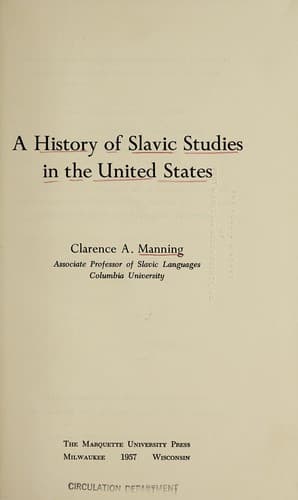
A history of Slavic studies in the United StatesManning, Clarence Augustus
History
A history of Slavic studies in the United States
Manning, Clarence Augustus
Slavic philology -- Study and teaching; Slavs -- History -- Study and teaching
Attempts to divide the entire area into regional sections with common
problems and cultural development produces only confusion, for such
divisions are applicable only to short periods in the ever-changing
kaleidoscope of history. The realization of this fact presents one of
the greatest obstacles to the student of present problems. The idea,
fostered in Prague, that the key to all East European problems could be
the assumption of a single Slavic history and Slavic culture can be
easily proved to be as vain as Pan-Germanism, Pan-Turanianism, and
Pan-Asianism.
Yet, today this over-simplification has been twisted by the Russian
Messianic concept into a formidable weapon against the rest of the
world. The Communist theories, like the old Tsarist theories of Moscow
as the Third Rome, cannot be laughed away. They must be met by accurate
and careful study and this does necessitate some sort of recognizable
division. But, the solution to these contradictions cannot be found in
either the Russian or the old Germanic theories; it demands the most
serious consideration from the modern scholars of the entire world
outside the Iron Curtain.
_III. Undergraduate Courses_
Considering the material that can be reasonably included in the
curriculum of the average American college, we must severely limit our
expectations. Because the average college aims to give a well rounded
education in many fields of knowledge, the number of persons
specializing in Slavic and East European subjects will be very limited.
The amount of time that the average student can spend on these subjects
and the amount of effort that the average institution will expend to
make them effective, is limited. Furthermore, there will be few
colleges, not connected with universities, either inclined to embark
upon an ambitious program, or supplied with the resources to undertake
it. But, this does not mean that nothing is to be done or that it is to
be done carelessly.
Until that time when the main facts of the history of Eastern Europe and
of Eastern European and Slavic culture are included in the general
scheme of the development of the modern world or in courses in the
development of contemporary civilization, interested persons on the
faculty must work out a minimum program. This will vary according to the
general content, either in history or literature, and will fall into its
proper place in the general curriculum, whether or not a special
department is established. There are some things that can be expected
and we will divide these into four headings: history, literature,
culture and language. We will here consider the first three.
Public-domain text, read in full here on John Shaqi.
Reviews
Reviews
No reviews yet
Be the first to share your thoughts on this work.
Elsewhere in the archive
Join the Discussion
Join the discussion
Sign in to leave a comment or review.
Sign InorCreate an account