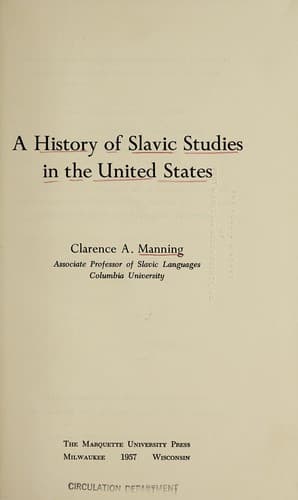
A history of Slavic studies in the United StatesManning, Clarence Augustus
History
A history of Slavic studies in the United States
Manning, Clarence Augustus
Slavic philology -- Study and teaching; Slavs -- History -- Study and teaching
The prime requirement in all these subjects is scientific accuracy,
something which is far too often honored in the breach. There has been
in the past too great a tendency to accept some superficial treatment
composed of half truths. We must remember that ignorance, and conscious
ignorance at that, is often better than incorrect knowledge. The problem
lies not so much in what a person does not know as in what he knows
wrong.
At the present time, there scarcely can be given a course in modern
history which overlooks and omits the questions that have been forced
upon the attention of the world by Russian Communism. There is,
therefore, little or no reason why the main facts of the present
situation should not be correctly given with proper weight laid on the
Soviet structure and methods. This involves a clear recognition that
there are important differences not only between the old capitalistic
and the new communistic Russia, but also that there is an ostensible
stress which the Soviet Union lays upon the differences between the
populations inhabiting her republics, subject as they all are to the
same Russianization. There can be no excuse for the oft repeated view
that all the people of the Soviet Union are Russians in the old sense of
the word. There is no reason for the arbitrary omission of the
nationality problem on the ground that it has no validity in fact or
experience just because it was denied by the Tsars a century ago. There
have been too many instances of even responsible publications omitting
from accurate surveys references to such problems, at the will of
certain anti-Communist nationalist Russian groups. Although there is
available today adequate and easily accessible literature, far too
little of it has penetrated the scholarly world which is still burdened
with the traditions of the past.
The same can be said of literature. For many years masterpieces of
Turgenev, Tolstoy, Dostoyevsky and Gorky have been included in courses
on modern European literature. Still, far too often, they have been
presented in a vacuum, without any attempt to equate them with Russian
life and thought. This is perhaps less common today, but immediately
after World War I, it is not extreme to say, there was a Western science
of Russian literature almost as far from reality as that first French
translation of _Anna Karenina_ which, in the interest of clarity, calmly
omitted the entire Levin-Kitty story.
Public-domain text, read in full here on John Shaqi.
Reviews
Reviews
No reviews yet
Be the first to share your thoughts on this work.
Elsewhere in the archive
Join the Discussion
Join the discussion
Sign in to leave a comment or review.
Sign InorCreate an account