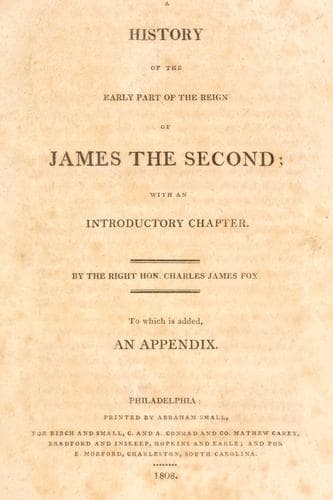
A History of the Early Part of the Reign of James the SecondFox, Charles James
History
A History of the Early Part of the Reign of James the Second
Fox, Charles James
Great Britain -- History -- James II, 1685-1688
The first years of this reign, under the administration of Southampton
and Clarendon, form by far the least exceptionable part of it; and even
in this period the executions of Argyle and Vane and the whole conduct of
the Government with respect to church matters, both in England and in
Scotland, were gross instances of tyranny. With respect to the execution
of those who were accused of having been more immediately concerned in
the king's death, that of Scrope, who had come in upon the proclamation,
and of the military officers who had attended the trial, was a violation
of every principle of law and justice. But the fate of the others,
though highly dishonourable to Monk, whose whole power had arisen from
his zeal in their service, and the favour and confidence with which they
had rewarded him, and not, perhaps, very creditable to the nation, of
which many had applauded, more had supported, and almost all had
acquiesced in the act, is not certainly to be imputed as a crime to the
king, or to those of his advisers who were of the Cavalier party. The
passion of revenge, though properly condemned both by philosophy and
religion, yet when it is excited by injurious treatment of persons justly
dear to us, is among the most excusable of human frailties; and if
Charles, in his general conduct, had shown stronger feelings of gratitude
for services performed to his father, his character, in the eyes of many,
would be rather raised than lowered by this example of severity against
the regicides. Clarendon is said to have been privy to the king's
receiving money from Louis XIV.; but what proofs exist of this charge
(for a heavy charge it is) I know not. Southampton was one of the very
few of the Royalist party who preserved any just regard for the liberties
of the people; and the disgust which a person possessed of such
sentiments must unavoidably feel is said to have determined him to quit
the king's service, and to retire altogether from public affairs. Whether
he would have acted upon this determination, his death, which happened in
the year 1667, prevents us now from ascertaining.
Public-domain text, read in full here on John Shaqi.
Reviews
Reviews
No reviews yet
Be the first to share your thoughts on this work.
Join the Discussion
Join the discussion
Sign in to leave a comment or review.
Sign InorCreate an account