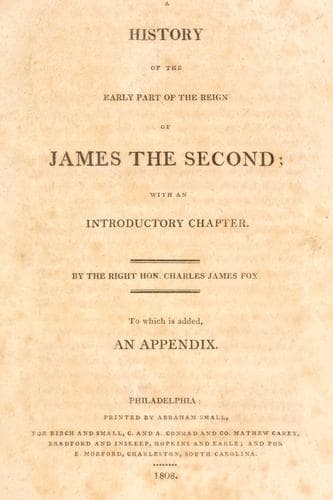
A History of the Early Part of the Reign of James the Second — John Shaqi
A History of the Early Part of the Reign of James the SecondFox, Charles James
History
A History of the Early Part of the Reign of James the Second
Fox, Charles James
Great Britain -- History -- James II, 1685-1688
After the fall of Clarendon, which soon followed, the king entered into
that career of misgovernment which, that he was able to pursue it to its
end, is a disgrace to the history of our country. If anything can add to
our disgust at the meanness with which he solicited a dependence upon
Louis XIV., it is, the hypocritical pretence upon which he was
continually pressing that monarch. After having passed a law, making it
penal to affirm (what was true) that he was a papist, he pretended (which
was certainly not true) to be a zealous and bigoted papist; and the
uneasiness of his conscience at so long delaying a public avowal of his
conversion, was more than once urged by him as an argument to increase
the pension, and to accelerate the assistance, he was to receive from
France. In a later period of his reign, when his interest, as he
thought, lay the other way, that he might at once continue to earn his
wages, and yet put off a public conversion, he stated some scruples,
contracted, no doubt, by his affection to the Protestant churches, in
relation to the popish mode of giving the sacrament, and pretended a wish
that the pope might be induced by Louis to consider of some alterations
in that respect, to enable him to reconcile himself to the Roman church
with a clear and pure conscience.
The ministry known by the name of the Cabal seems to have consisted of
characters so unprincipled, as justly to deserve the severity with which
they have been treated by all writers who have mentioned them; but if it
is probable that they were ready to betray their king, as well as their
country, it is certain that the king betrayed them, keeping from them the
real state of his connexion with France, and from some of them, at least,
the secret of what he was pleased to call his religion. Whether this
concealment on his part arose from his habitual treachery, and from the
incapacity which men of that character feel of being open and honest,
even when they know it is their interest to be so, or from an
apprehension that they might demand for themselves some share of the
French money, which he was unwilling to give them, cannot now be
determined. But to the want of genuine and reciprocal confidence between
him and those ministers is to be attributed, in a great measure, the
escape which the nation at that time experienced--an escape, however,
which proved to be only a reprieve from that servitude to which they were
afterwards reduced in the latter years of the reign.
Public-domain text, read in full here on John Shaqi.
Reviews
Reviews
No reviews yet
Be the first to share your thoughts on this work.
Join the Discussion
Join the discussion
Sign in to leave a comment or review.
Sign InorCreate an account