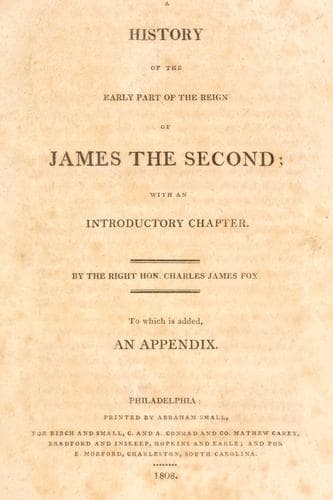
A History of the Early Part of the Reign of James the SecondFox, Charles James
History
A History of the Early Part of the Reign of James the Second
Fox, Charles James
Great Britain -- History -- James II, 1685-1688
Besides the important consequences produced by this second Dutch war in
England, it gave birth to two great events in Holland; the one as
favourable as the other was disastrous to the cause of general liberty.
The catastrophe of De Witt, the wisest, best, and most truly patriotic
minister that ever appeared upon the public stage, as it was an act of
the most crying injustice and ingratitude, so, likewise, is it the most
completely discouraging example that history affords to the lovers of
liberty. If Aristides was banished, he was also recalled; if Dion was
repaid for his services to the Syracusans by ingratitude, that
ingratitude was more than once repented of; if Sidney and Russell died
upon the scaffold, they had not the cruel mortification of falling by the
hands of the people; ample justice was done to their memory, and the very
sound of their names is still animating to every Englishman attached to
their glorious cause. But with De Witt fell also his cause and his
party; and although a name so respected by all who revere virtue and
wisdom, when employed in their noblest sphere, the political service of
the public, must undoubtedly be doubly dear to his countrymen, yet I do
not know that, even to this day, any public honours have been paid by
them to his memory.
On the other hand, the circumstances attending the first appearance of
the Prince of Orange in public affairs, were, in every respect, most
fortunate for himself, for England, for Europe. Of an age to receive the
strongest impressions, and of a character to render such impressions
durable, he entered the world in a moment when the calamitous situation
of the United Provinces could not but excite in every Dutchman the
strongest detestation of the insolent ambition of Louis XIV., and the
greatest contempt of an English government, which could so far mistake or
betray the interests of the country as to lend itself to his projects.
Accordingly, the circumstances attending his outset seem to have given a
lasting bias to his character; and through the whole course of his life
the prevailing sentiments of his mind seem to have been those which he
imbibed at this early period. These sentiments were most peculiarly
adapted to the positions in which this great man was destined to be
placed. The light in which he viewed Louis rendered him the fittest
champion of the independence of Europe; and in England, French influence
and arbitrary power were in those times so intimately connected, that he
who had not only seen with disapprobation, but had so sensibly felt the
baneful effects of Charles's connection with France, seemed educated, as
it were, to be the defender of English liberty. This prince's struggles
in defence of his country, his success in rescuing it from a situation to
all appearance so desperate, and the consequent failure and mortification
of Louis XIV., form a scene in history upon which the mind dwells with
unceasing delight.
Public-domain text, read in full here on John Shaqi.
Reviews
Reviews
No reviews yet
Be the first to share your thoughts on this work.
Join the Discussion
Join the discussion
Sign in to leave a comment or review.
Sign InorCreate an account