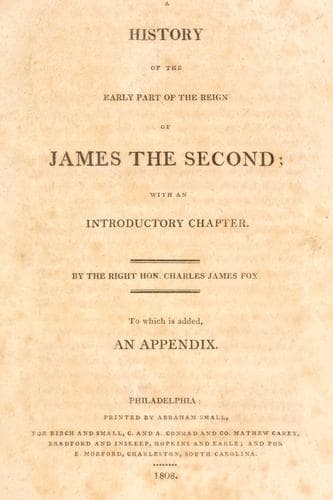
A History of the Early Part of the Reign of James the SecondFox, Charles James
History
A History of the Early Part of the Reign of James the Second
Fox, Charles James
Great Britain -- History -- James II, 1685-1688
The first Dutch war had been undertaken against all maxims of policy as
well as of justice; but the superior infamy of the second, aggravated by
the disappointment of all the hopes entertained by good men from the
triple alliance, and by the treacherous attempt at piracy with which it
was commenced, seems to have effaced the impression of it, not only from
the minds of men living at the time, but from most of the writers who
have treated of this reign. The principle, however, of both was the
same, and arbitrary power at home was the object of both. The second
Dutch war rendered the king's system and views so apparent to all who
were not determined to shut their eyes against conviction, that it is
difficult to conceive how persons who had any real care or regard either
for the liberty or honour of the country, could trust him afterwards. And
yet even Sir William Temple, who appears to have been one of the most
honest, as well as of the most enlightened, statesmen of his time, could
not believe his treachery to be quite so deep as it was in fact, and
seems occasionally to have hoped that he was in earnest in his professed
intentions of following the wise and just system that was recommended to
him. Great instances of credulity and blindness in wise men are often
liable to the suspicion of being pretended, for the purpose of justifying
the continuing in situations of power and employment longer than strict
honour would allow. But to Temple's sincerity his subsequent conduct
gives abundant testimony. When he had reason to think that his services
could no longer be useful to his country he withdrew wholly from public
business, and resolutely adhered to the preference of philosophical
retirement, which, in his circumstances, was just, in spite of every
temptation which occurred to bring him back to the more active scene. The
remainder of his life he seems to have employed in the most noble
contemplations and the most elegant amusements; every enjoyment
heightened, no doubt, by reflecting on the honourable part he had acted
in public affairs, and without any regret on his own account (whatever he
might feel for his country) at having been driven from them.
Public-domain text, read in full here on John Shaqi.
Reviews
Reviews
No reviews yet
Be the first to share your thoughts on this work.
Join the Discussion
Join the discussion
Sign in to leave a comment or review.
Sign InorCreate an account