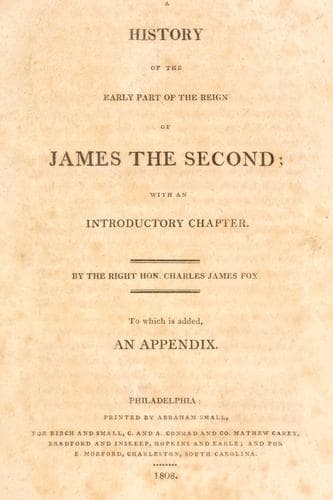
A History of the Early Part of the Reign of James the Second — John Shaqi
A History of the Early Part of the Reign of James the SecondFox, Charles James
History
A History of the Early Part of the Reign of James the Second
Fox, Charles James
Great Britain -- History -- James II, 1685-1688
The dispute was no longer, whether or not the dangers resulting from
James's succession were real, and such as ought to be guarded against by
parliamentary provisions, but whether the exclusion or restrictions
furnished the most safe and eligible mode of compassing the object which
both sides pretended to have in view. The argument upon this state of
the question is clearly, forcibly, and, I think, convincingly, stated by
Rapin, who exposes very ably the extreme folly of trusting to measures,
without consideration of the men who are to execute them. Even in Hume's
statement of the question, whatever may have been his intention, the
arguments in favour of the exclusion appear to me greatly to
preponderate. Indeed, it is not easy to conceive upon what principles
even the Tories could justify their support of the restrictions. Many
among them, no doubt, saw the provisions in the same light in which the
Whigs represented them, as an expedient, admirably, indeed, adapted to
the real object of upholding the present king's power, by the defeat of
the exclusion, but never likely to take effect for their pretended
purpose of controlling that of his successor, and supported them for that
very reason. But such a principle of conduct was too fraudulent to be
avowed; nor ought it, perhaps, in candour to be imputed to the majority
of the party. To those who acted with good faith, and meant that the
restrictions should really take place and be effectual, surely it ought
to have occurred (and to those who most prized the prerogatives of the
crown it ought most forcibly to have occurred), that in consenting to
curtail the powers of the crown, rather than to alter the succession,
they were adopting the greater in order to avoid the lesser evil. The
question of what are to be the powers of the crown, is surely of superior
importance to that of who shall wear it? Those, at least, who consider
the royal prerogative as vested in the king, not for his sake but for
that of his subjects, must consider the one of these questions as much
above the other in dignity as the rights of the public are more valuable
than those of an individual. In this view the prerogatives of the crown
are, in substance and effect, the rights of the people; and these rights
of the people were not to be sacrificed to the purpose of preserving the
succession to the most favoured prince much less to one who, on account
of his religious persuasion, was justly feared and suspected. In truth,
the question between the exclusion and restrictions seems peculiarly
calculated to ascertain the different views in which the different
parties in this country have seen, and perhaps ever will see, the
prerogatives of the crown. The Whigs, who consider them as a trust for
the people--a doctrine which the Tories themselves, when pushed in
argument, will sometimes admit--naturally think it their duty rather to
change the manager of the trust than to impair the subject of it; while
Public-domain text, read in full here on John Shaqi.
Reviews
Reviews
No reviews yet
Be the first to share your thoughts on this work.
Join the Discussion
Join the discussion
Sign in to leave a comment or review.
Sign InorCreate an account