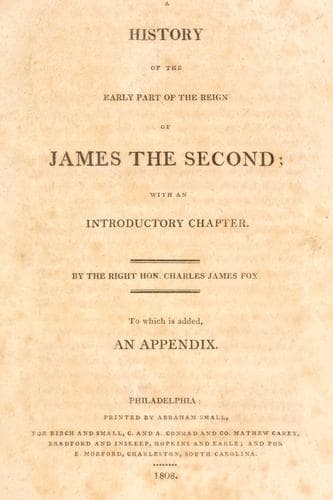
A History of the Early Part of the Reign of James the Second — John Shaqi
A History of the Early Part of the Reign of James the SecondFox, Charles James
History
A History of the Early Part of the Reign of James the Second
Fox, Charles James
Great Britain -- History -- James II, 1685-1688
others, who consider them as the right or property of the king, will as
naturally act as they would do in the case of any other property, and
consent to the loss or annihilation of any part of it, for the purpose of
preserving the remainder to him whom they style the rightful owner. If
the people be the sovereign and the king the delegate, it is better to
change the bailiff than to injure the farm; but if the king be the
proprietor, it is better the farm should be impaired--nay, part of it
destroyed--than that the whole should pass over to an usurper. The royal
prerogative ought, according to the Whigs (not in the case of a popish
successor only, but in all cases), to be reduced to such powers as are in
their exercise beneficial to the people; and of the benefit of these they
will not rashly suffer the people to be deprived, whether the executive
power be in the hands of an hereditary or of an elected king, of a
regent, or of any other denomination of magistrate; while, on the other
hand, they who consider prerogative with reference only to royalty, will,
with equal readiness, consent either to the extension or the suspension
of its exercise, as the occasional interests of the prince may seem to
require. The senseless plea of a divine and indefeasible right in James,
which even the legislature was incompetent to set aside, though as
inconsistent with the declarations of parliament in the statute book, and
with the whole practice of the English constitution, as it is repugnant
to nature and common sense, was yet warmly insisted upon by the high
church party. Such an argument, as might naturally be expected, operated
rather to provoke the Whigs to perseverance than to dissuade them from
their measure: it was, in their eyes, an additional merit belonging to
the exclusion bill that it strengthened, by one instance more, the
authority of former statutes in reprobating a doctrine which seems to
imply that man can have a property in his fellow-creatures. By far the
best argument in favour of the restrictions, is the practical one that
they could be obtained, and that the exclusion could not; but the value
of this argument is chiefly proved by the event. The exclusionists had a
fair prospect of success, and their plan being clearly the best, they
were justified in pursuing it.
Public-domain text, read in full here on John Shaqi.
Reviews
Reviews
No reviews yet
Be the first to share your thoughts on this work.
Join the Discussion
Join the discussion
Sign in to leave a comment or review.
Sign InorCreate an account