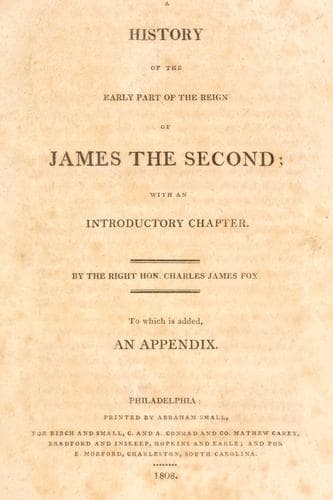
A History of the Early Part of the Reign of James the SecondFox, Charles James
History
A History of the Early Part of the Reign of James the Second
Fox, Charles James
Great Britain -- History -- James II, 1685-1688
Of the Rye House plot it may be said, much more truly than of the popish,
that there was in it some truth, mixed with much falsehood; and though
many of the circumstances in Kealing's account are nearly as absurd and
ridiculous as those in Oates's, it seems probable that there was among
some of those accused a notion of assassinating the king; but whether
this notion was over ripened into what may be called a design, and, much
more, whether it were ever evinced by such an overt act as the law
requires for conviction, is very doubtful. In regard to the conspirators
of higher ranks, from whom all suspicion of participation in the intended
assassination has been long since done away, there is unquestionably
reason to believe that they had often met and consulted, as well for the
purpose of ascertaining the means they actually possessed as for that of
devising others for delivering their country from the dreadful servitude
into which it had fallen; and thus far their conduct appears clearly to
have been laudable. If they went further, and did anything which could
be fairly construed into an actual conspiracy to levy war against the
king, they acted, considering the disposition of the nation at that
period, very indiscreetly. But whether their proceedings had ever gone
this length, is far from certain. Monmouth's communications with the
king, when we reflect upon all the circumstances of those communications,
deserve not the smallest attention; nor indeed, if they did, does the
letter which he afterwards withdrew prove anything upon this point. And
it is an outrage to common-sense to call Lord Grey's narrative written,
as he himself states in his letter to James II., while the question of
his pardon was pending, an authentic account. That which is most certain
in this affair is, that they had committed no overt act, indicating the
imagining of the king's death, even according to the most strained
construction of the statute of Edward III.; much less was any such act
legally proved against them. And the conspiring to levy war was not
treason, except by a recent statute of Charles II., the prosecutions upon
which were expressly limited to a certain time, which in these cases had
elapsed so that it is impossible not to assent to the opinion of those
who have ever stigmatised the condemnation and execution of Russell as a
most flagrant violation of law and justice.
Public-domain text, read in full here on John Shaqi.
Reviews
Reviews
No reviews yet
Be the first to share your thoughts on this work.
Join the Discussion
Join the discussion
Sign in to leave a comment or review.
Sign InorCreate an account